Frogs of Borneo

Frogs of Borneo

Frogs of Borneo

Frogs of Borneo

Frogs of Borneo

Frogs of Borneo

Frogs of Borneo

Frogs of Borneo

Frogs of Borneo

Frogs of Borneo

Frogs of Borneo
Filter
Ansonia hanitschi
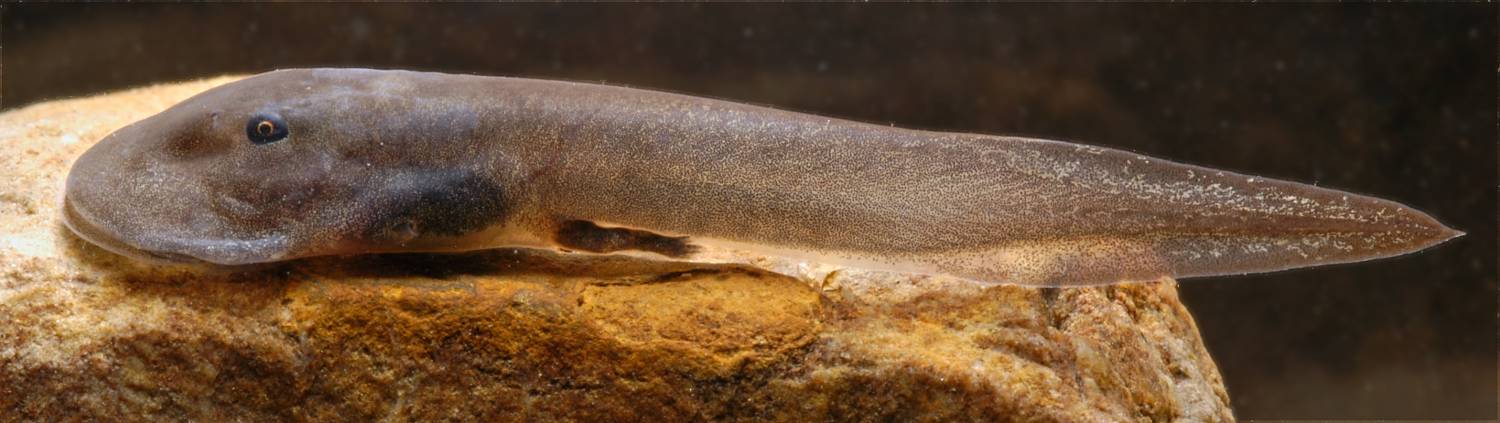
A highland species. Tadpoles occur on and among rocks in montane streams. They adhere tightly to rock substrates using their suctorial oral discs and preferentially occupy strong currents, often in foaming water such as small waterfalls and cascades. Tadpoles are most frequently observed on vertical, smooth rock faces. When disturbed, individuals detach rapidly and seek refuge beneath rocks. Tadpoles have also been observed leaving the water to graze on algal growth on rocks within the spray zone of small waterfalls. During daylight hours, they typically shelter at the bases of rocks within the stream, ascending to algae-rich rock surfaces at night, where they may be observed grazing in groups.
-
Family:Bufonidae
-
Genus:Ansonia
-
Ecomorph:exotrophic, lotic, rheophilous, suctorial
-
Waterbody Type:flowing
-
Water Column:rock surface
-
Feeding Type:feeding, hard surface grazer, omnivorous, rasping
-
Size:33 mm
-
Development:larva, tadpole
-
Adult:Ansonia
Coloration
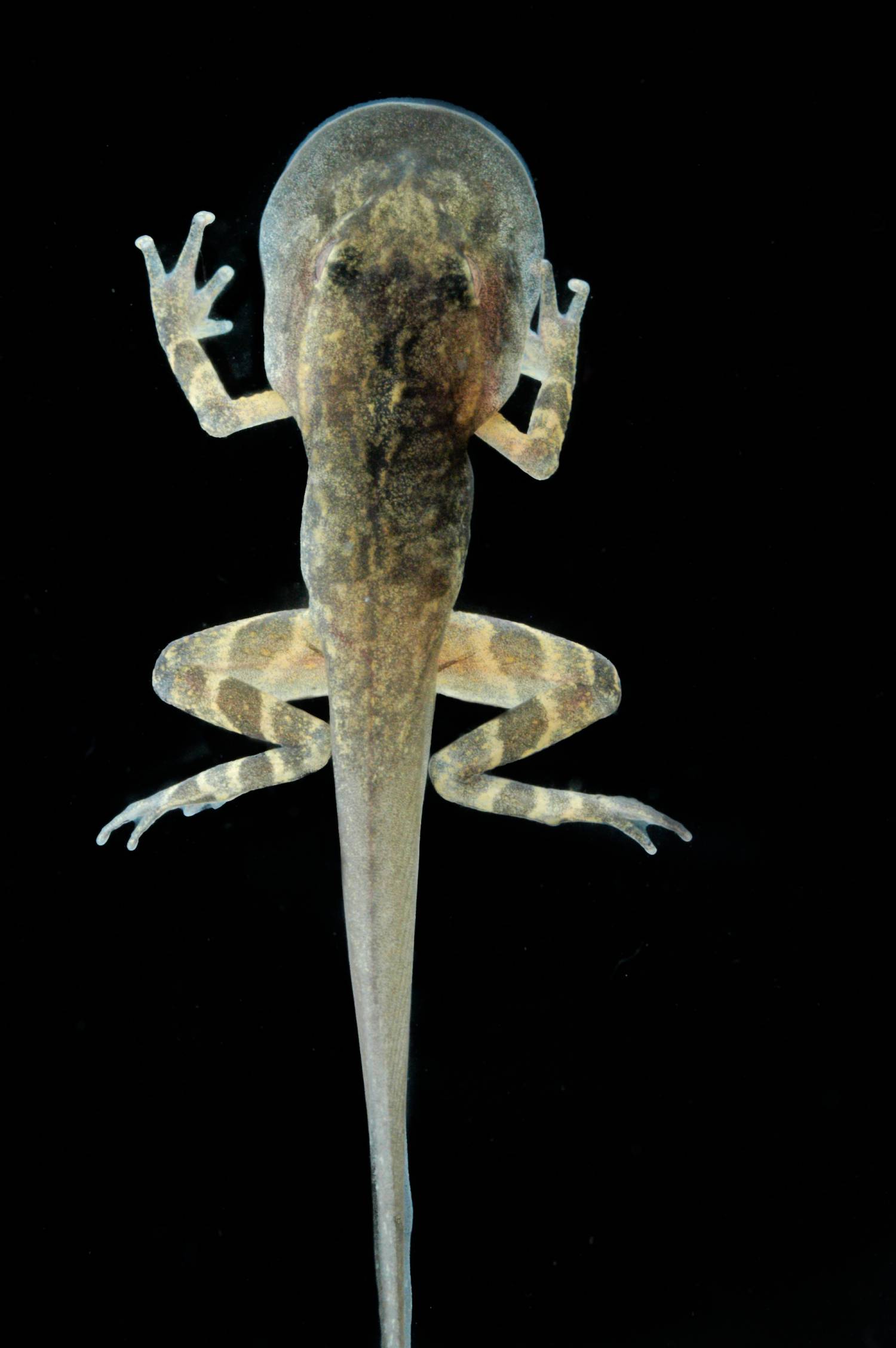
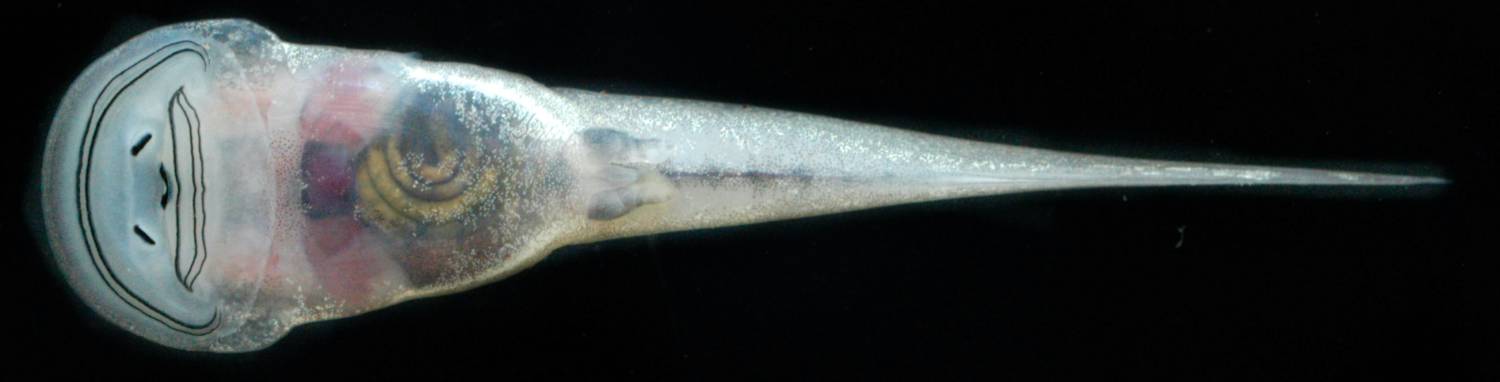
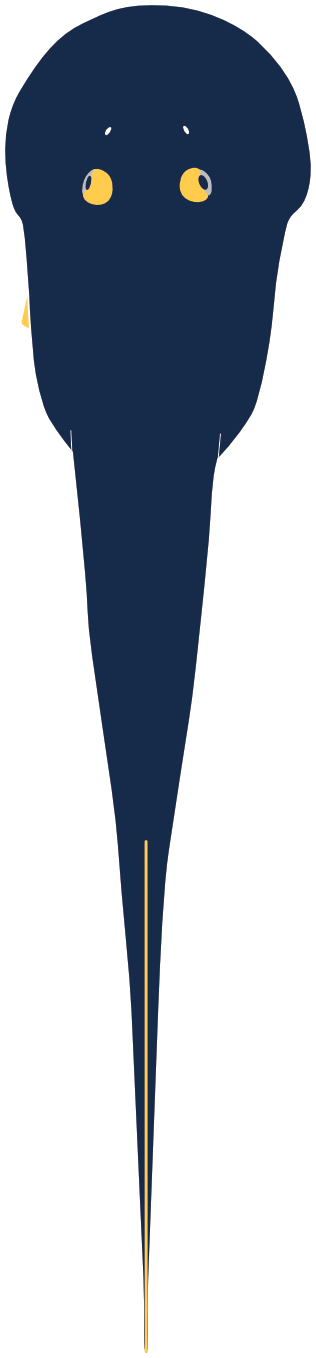
Dorsally, tadpoles are uniformly and densely stippled dark gray, with pigmentation extending partially onto the muscular portion of the tail. Tail fins are pigmented along their margins, with a slightly less pigmented stripe at the junction with the tail musculature. In advanced developmental stages with well-developed hind limbs, the characteristic dorsal color pattern of the metamorphosing toadlet becomes apparent. The venter is unpigmented, rendering internal organs visible, but in later stages these gradually become obscured by melanophores and iridophores spreading onto the belly from the sides.
Snout
Snout flat and very broadly expanded; long and sloping in lateral profile, resulting in a highly streamlined appearance.
Oral Disc
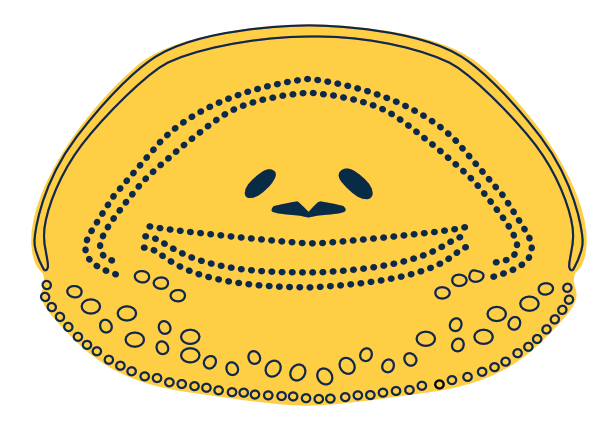
Oral disc forming a large ventral sucker, approximately as wide as the maximum body width. Lower lip bearing a row of small marginal papillae; upper lip forming a smooth bulge. Two rows of flattened submarginal papillae present on the lower lip. Labial keratodont row formula 2/3, with all rows undivided. Upper keratodont rows very long, extending well beyond the lateral ends of the lower rows and curving inward distally. Upper beak widely divided; lower beak undivided and medially thin.
Body
In dorsal view, body contour inverted pear-shaped, narrowing abruptly at the transition from head to trunk. Body dorsoventrally depressed. Spiracle sinistral, attached to the body wall, and positioned well below the midlevel in lateral view.
Eyes & Nostrils
Eyes dorsolateral, positioned far from the body margin in dorsal view. Nostrils small, located much closer to the eyes than to the tip of the snout. Iris black, with a silvery, occasionally coppery, ring bordering the pupil.
Tail
Tail strong and muscular, nearly as high as the body in lateral view. Fins low; dorsal fin restricted to the posterior half of the tail, rising at approximately 40% of tail length. Ventral fin originating at the vent and remaining low for most of its length. Fins taper gradually and terminate in a pointed tip, often forming a short, sharp terminal filament.
Similar Species
Ansonia hanitschi possesses the largest tadpoles among the known Bornean Ansonia. A combination of large size (up to 33 mm), oral disc characteristics (very long, coiled upper keratodont rows), reduced tail fins, presence of a terminal tail filament, and restriction to montane habitats distinguishes this species from most other Ansonia tadpoles, except A. kelabitensis, for which reliable distinguishing characters have not yet been established (Matsui et al. 2020). Additionally, the tadpoles of several closely related species remain undescribed. Tadpoles of A. hanitschi may occur syntopically with larvae of Meristogenys and Huia, both of which possess a gastric sucker, a feature absent in Ansonia.
Literature
Malkmus et al. (2002) reported that males call from river banks and rocks during the day. Females in captivity produced 45–73 eggs in a jelly string that was attached to submerged rocks (Herrmann and Ulber 1992).
Haas, A., Das, I. (2008) Larval identities of Ansonia hanitschi Inger, 1960 (Amphibia: Bufonidae) and Polypedates colletti (Boulenger, 1890) (Amphibia: Rhacophoridae) from East Malaysia (Borneo). Salamandra 44: 85–100.
Herrmann, H.J., Ulber, T. (1992) Über Haltung sowie Verhalten von Ansonia hanitschi Inger, 1960 (Anura: Bufonidae) in Biotop und Terrarium. Sauria 14: 15–18. [in German]
Malkmus, R., Manthey, U., Vogel, G., Hoffmann, P., Kosuch, J. (2002) Amphibians & Reptiles of Mount Kinabalu (North Borneo). Koeltz Scientific Books, Königstein. 424 pp.
Matsui, M., Nishikawa, K., Eto, K., Hossman, M.Y. (2020) Two new Ansonia from mountains of Borneo (Anura, Bufonidae). Zoological Science 37: 1–12.
Herrmann, H.J., Ulber, T. (1992) Über Haltung sowie Verhalten von Ansonia hanitschi Inger, 1960 (Anura: Bufonidae) in Biotop und Terrarium. Sauria 14: 15–18. [in German]
Malkmus, R., Manthey, U., Vogel, G., Hoffmann, P., Kosuch, J. (2002) Amphibians & Reptiles of Mount Kinabalu (North Borneo). Koeltz Scientific Books, Königstein. 424 pp.
Matsui, M., Nishikawa, K., Eto, K., Hossman, M.Y. (2020) Two new Ansonia from mountains of Borneo (Anura, Bufonidae). Zoological Science 37: 1–12.