Zum Hauptinhalt springen

Frogs of Borneo

Frogs of Borneo

Frogs of Borneo

Frogs of Borneo

Frogs of Borneo

Frogs of Borneo

Frogs of Borneo

Frogs of Borneo

Frogs of Borneo

Frogs of Borneo

Frogs of Borneo

Feihyla inexpectata

The species was originally described from the type locality at Nepenthes Camp, Maliau Basin. We recorded tadpoles and adults both from this site and from lowland primary forest at Gunung Mulu. In addition, sightings from Danum Valley have been reported to us. This anecdotal evidence suggests that the species may have a wide distribution in northeastern Borneo. The tadpoles inhabit swampy forest pools.
  • Family:
    Rhacophoridae
  • Genus:
    Feihyla
  • Ecomorph:
    benthic, exotrophic, lentic
  • Waterbody Type:
    stagnant
  • Water Column:
    bottom
  • Feeding Type:
    feeding, generalist
  • Size:
    ? mm
  • Development:
    larva, tadpole
  • Adult:
    Feihyla

Coloration

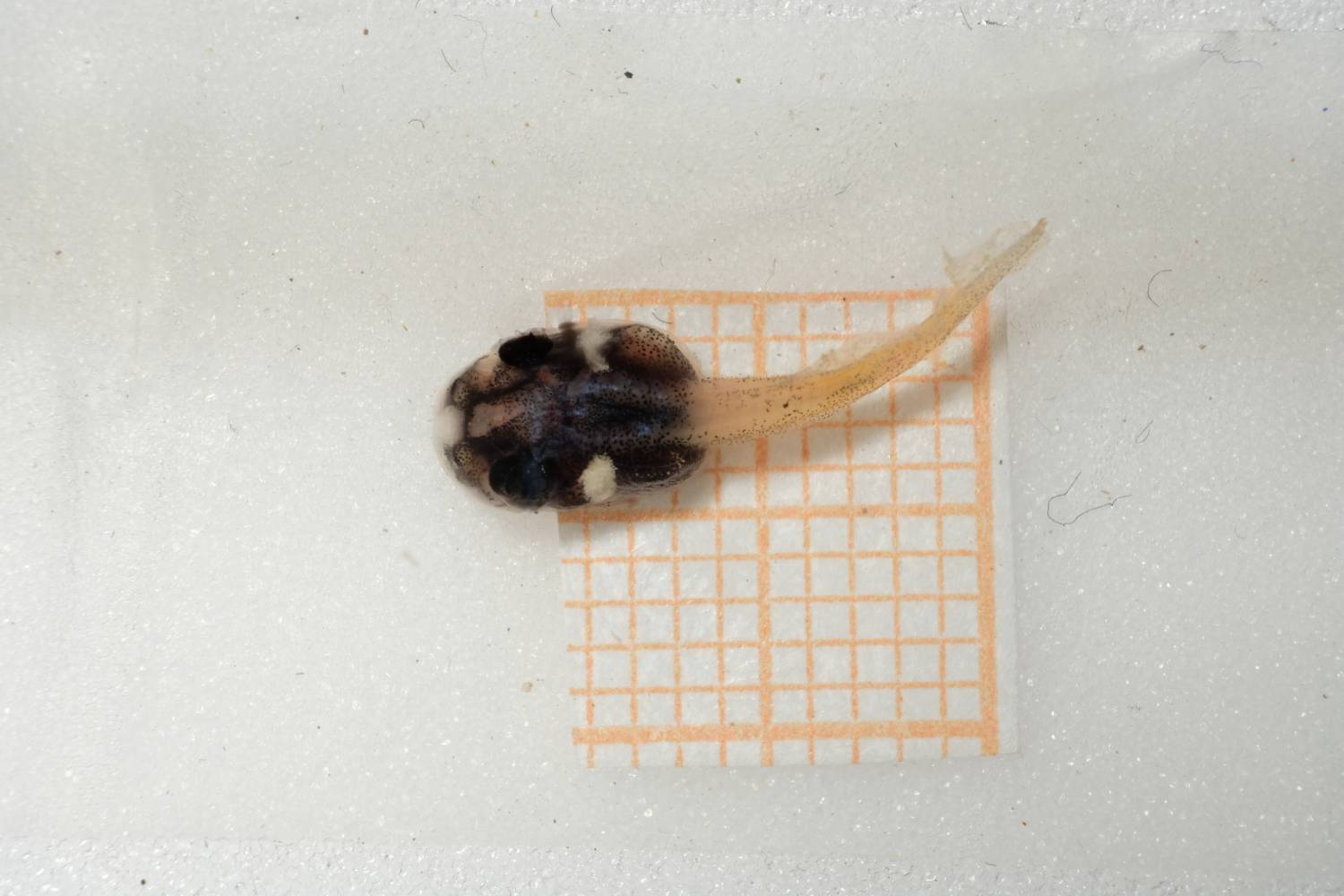
The tip of the snout bears a bright white patch. An elongated white blotch runs from dorsal to ventral in the anterior part of the trunk, just posterior the head’s gill region. The remaining body is dark brown. In contrast, the tail is only lightly pigmented. The color pattern was described from relatively early stage, free-swimming tadpoles (15 mm total length) and the pattern may change towards metamorphosis.

Snout

The snout is bluntly rounded from above; slightly tapering and rounded in profile.

Oral Disc

Details have not been registered yet.

Body

Body shape in dorsal view resembles a smoothly rounded rectangle.

Eyes & Nostrils

Eyes lateral in position, cornea extends beyond body contour in dorsal view. The iris bears a coppery ring around the pupil.

Tail

The tail, although damaged, represents 60.7% of the total length in a small specimen (15 mm total length). Proportions may change during larval growth.

Similar Species

The unique color pattern of these tadpoles makes misidentification unlikely. Tadpoles of the related species F. kajau exhibit a different pattern and have been reported from nearly stagnant sections of small streams; F. kajau does not use forest ponds for reproduction.

Literature

Individuals perched 1–3 m high on vegetation close to the breeding pool. Males were observed to call from above as well as from under leaves.
Matsui, M., Shimada, T., Sudin, A. (2014) First record of the treefrog genus Chiromantis from Borneo with the description of a new species (Amphibia: Rhacophoridae). Zoological Science 31: 45–51.

Haas, A., BoonHee, K., Joseph, A., bin Asri, M., Das, I., Hagmann, R., Schwander, L., Hertwig, S.T. (2018) An updated checklist of the amphibian diversity of Maliau Basin Conservation Area, Sabah, Malaysia. Evolutionary Systematics 2: 89–114.