Frogs of Borneo

Frogs of Borneo

Frogs of Borneo

Frogs of Borneo

Frogs of Borneo

Frogs of Borneo

Frogs of Borneo

Frogs of Borneo

Frogs of Borneo

Frogs of Borneo

Frogs of Borneo
Filter
Kalophrynus intermedius
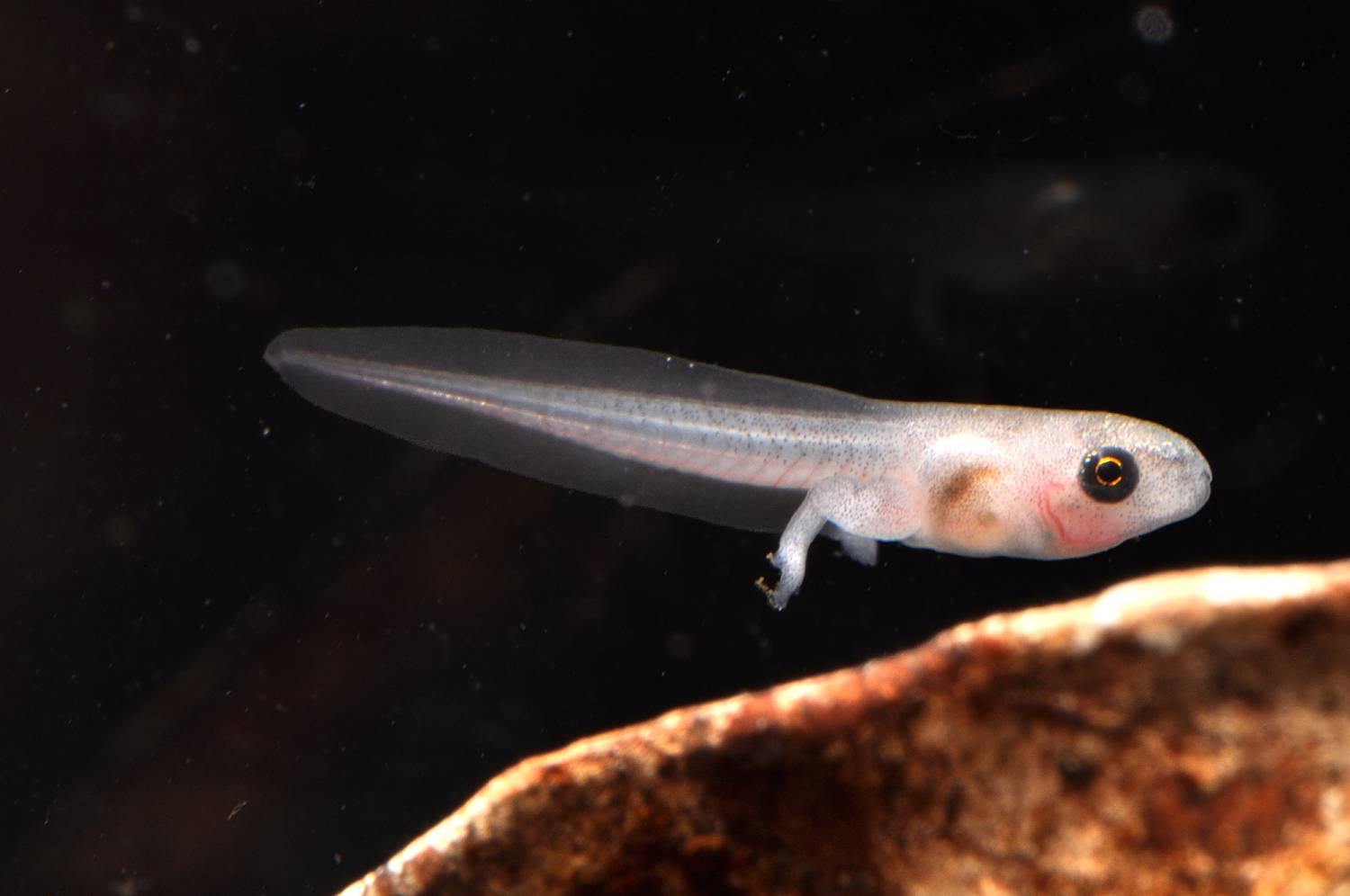
Some larvae of Kalophrynus intermedius depicted here were found in a partially water-filled tin in disturbed vegetation at the forest edge. Adults identified as Kalophrynus intermedius were calling nearby, and the larvae were tentatively assigned to this species. Only nine larvae were discovered in the container. Despite advanced developmental stages in some individuals (presence of hind limb development), body size was very small, and all larvae possessed cream-colored guts. This indicates an endotrophic lifestyle that does not require uptake of nutrients from external sources.
-
Family:Microhylidae
-
Genus:Kalophrynus
-
Ecomorph:endotrophic
-
Waterbody Type:phytotelma
-
Water Column:—
-
Feeding Type:non-feeding
-
Size:11 mm
-
Development:larva, tadpole
-
Adult:Kalophrynus
Coloration
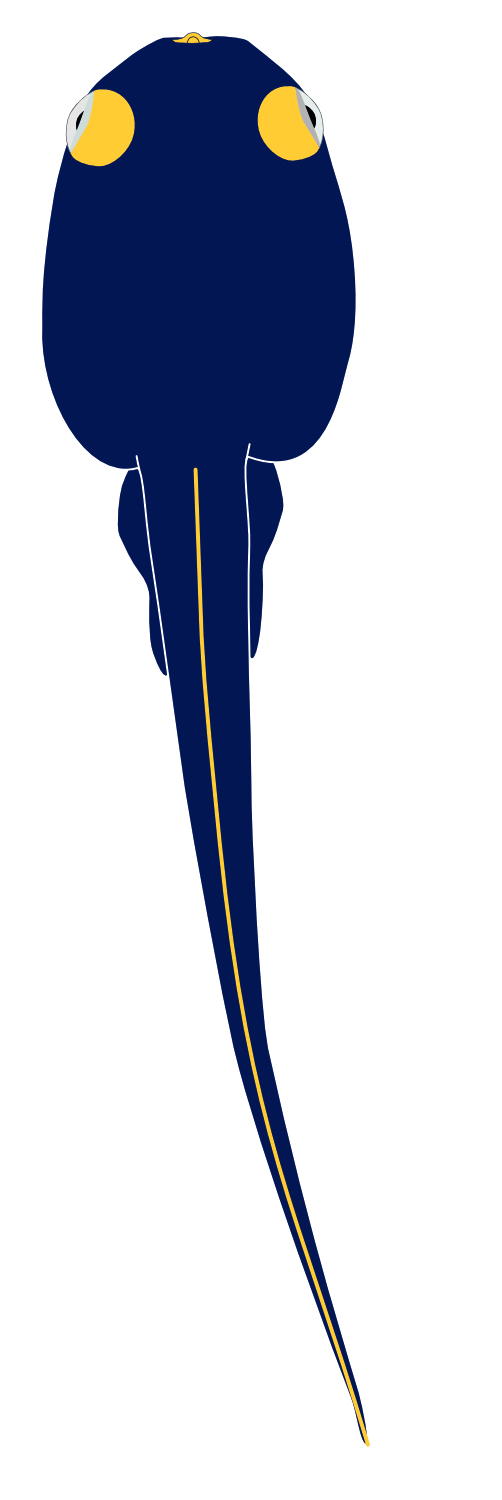
Dorsal coloration uniformly dark brown, without distinct pattern. Body coloration extends onto the tail and tail fins but fades rapidly toward the posterior and ventral portions of the tail. Density of melanocytes decreases laterally toward the ventral side. Ventral surface transparent. Gut coil visible in lateral and ventral views. Ventral gular and buccal regions lightly dusted with melanocytes. Heart and major blood vessels visible in ventral view.
Snout
Snout very short and bluntly rounded in lateral view. In dorsal view, rounded, medially truncated, or shallowly emarginated.
Oral Disc
Mouth terminal; oral disc absent. Mouth small, recessed within a horizontal fold at the tip of the snout. Upper jaw shallowly arched; lower jaw wide and U-shaped. Keratinized jaw sheaths and keratodonts absent (LTRF 0/0).
Body
Tadpole very small overall. Head and trunk slightly dorsoventrally depressed. In dorsal view, head not clearly demarcated from trunk; both relatively wide. Trunk broadly rounded posteriorly and much wider than the base of the tail. In lateral view, head bluntly rounded anteriorly, snout short. Body widest at the trunk region. Spiracle ventral and medial, positioned at mid-belly level. Spiracular orifice forming a simple shallow arch opening posteriorly, without a flap.
Eyes & Nostrils
Eyes relatively large, positioned laterally, and widely spaced. Cornea protruding beyond the body contour in dorsal and ventral views. Iris mostly black with a metallic golden ring around the pupil; eyeball beyond the iris dotted with silver iridophores. Nostrils not perforated in larval stages.
Tail
Tail long, comprising approximately 69% of total length. Muscular portion moderately developed, approximately half of body height in lateral view and less than half of trunk width in dorsal view. Upper fin originating at the trunk-tail junction, remaining low for a short distance before rising into a shallow convex arch; upper fin relatively low. Upper and lower fins subequal in height. In the posterior half of the tail, fins symmetrical and taper weakly to a moderately narrowly rounded tip. Overall tail-fin shape lanceolate. Skin glands absent. Lateral tail vein indistinct. Muscle myosepta visible under high magnification, anteriorly slightly accentuated by pigmentation.
Similar Species
Larval stages of Kalophrynus have rarely been reported. It has been suggested that Kalophrynus may use pitchers of Nepenthes for oviposition; however, some reports may have confused larvae of Microhyla nepenthicola with Kalophrynus tadpoles. The Kalophrynus intermedius larvae described here and tadpoles of M. nepenthicola are superficially similar but can be distinguished by tail-tip morphology, which is pointed and cuspidate in M. nepenthicola. Kalophrynus tadpoles may also be confused with larvae of Metaphrynella; see comments under Metaphrynella sundana. Inger (1985) provided a description of larval K. meizon (as K. pleurostigma), but without accompanying photographs.
Literature
Phytotelmata or similarly small containers with water are used for egg deposition.
Inger, R.F. (1966) The systematics and zoogeography of the Amphibia of Borneo. Fieldiana Zoology 52: 1–402.
Inger, R.F. (1985) Tadpoles of the forested regions of Borneo. Fieldiana Zoology new series 26:1–89.
Inger, R.F., Stuebing, R.B., Grafe, T.U., Dehling, J.M. (2017) A field guide to the frogs of Borneo. 3rd ed. Natural History Books, Kota Kinabalu. 228 pp.
Malkmus, R., Dehling, J.M. (2008) Anuran amphibians of Borneo as phytotelm-breeders—a synopsis. Herpetozoa 20: 165–172.
Inger, R.F. (1985) Tadpoles of the forested regions of Borneo. Fieldiana Zoology new series 26:1–89.
Inger, R.F., Stuebing, R.B., Grafe, T.U., Dehling, J.M. (2017) A field guide to the frogs of Borneo. 3rd ed. Natural History Books, Kota Kinabalu. 228 pp.
Malkmus, R., Dehling, J.M. (2008) Anuran amphibians of Borneo as phytotelm-breeders—a synopsis. Herpetozoa 20: 165–172.