Frogs of Borneo

Frogs of Borneo

Frogs of Borneo

Frogs of Borneo

Frogs of Borneo

Frogs of Borneo

Frogs of Borneo

Frogs of Borneo

Frogs of Borneo

Frogs of Borneo

Frogs of Borneo
Filter
Leptobrachium gunungense
This species inhabits highland primary forests at elevations between 1750 and 2200 m a.s.l., reaching into the mossy forest zone. The occupied streams are typically rocky, clear, often steep, and narrow. Tadpoles have also been observed in high-elevation blackwater streams. They are not specifically adapted to life in strong currents and are consistently found in quiet sections of streams with low to moderate flow, where they dwell on the bottom. Details of larval development have not been documented; however, development is likely prolonged in the cold waters of mountain streams. Mixed developmental stages are commonly present within the same stream.
-
Family:Megophryidae
-
Genus:Leptobrachium
-
Ecomorph:benthic, exotrophic, lotic
-
Waterbody Type:flowing
-
Water Column:bottom
-
Feeding Type:feeding, generalist
-
Size:65 mm
-
Development:larva, tadpole
-
Adult:Leptobrachium
Coloration
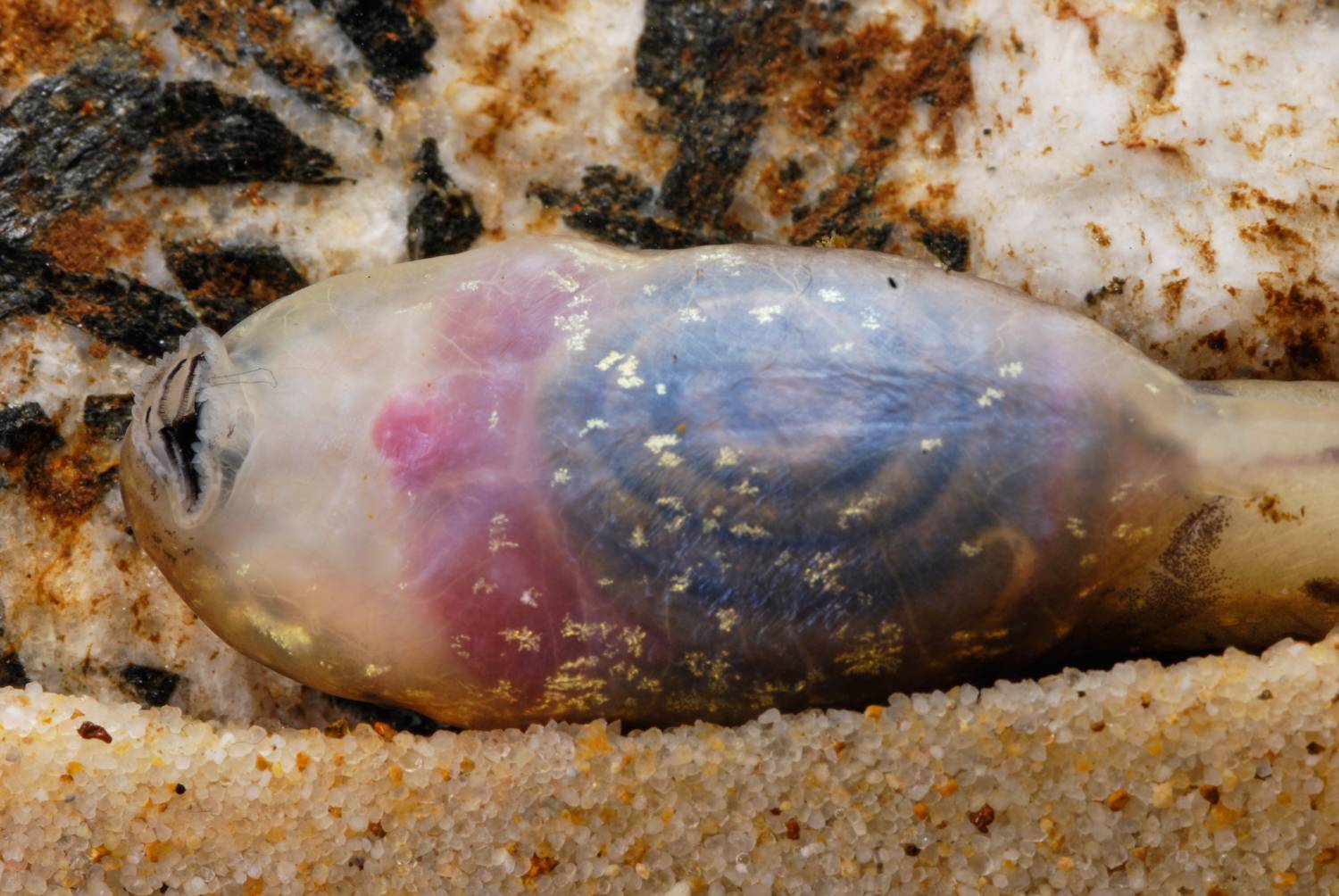
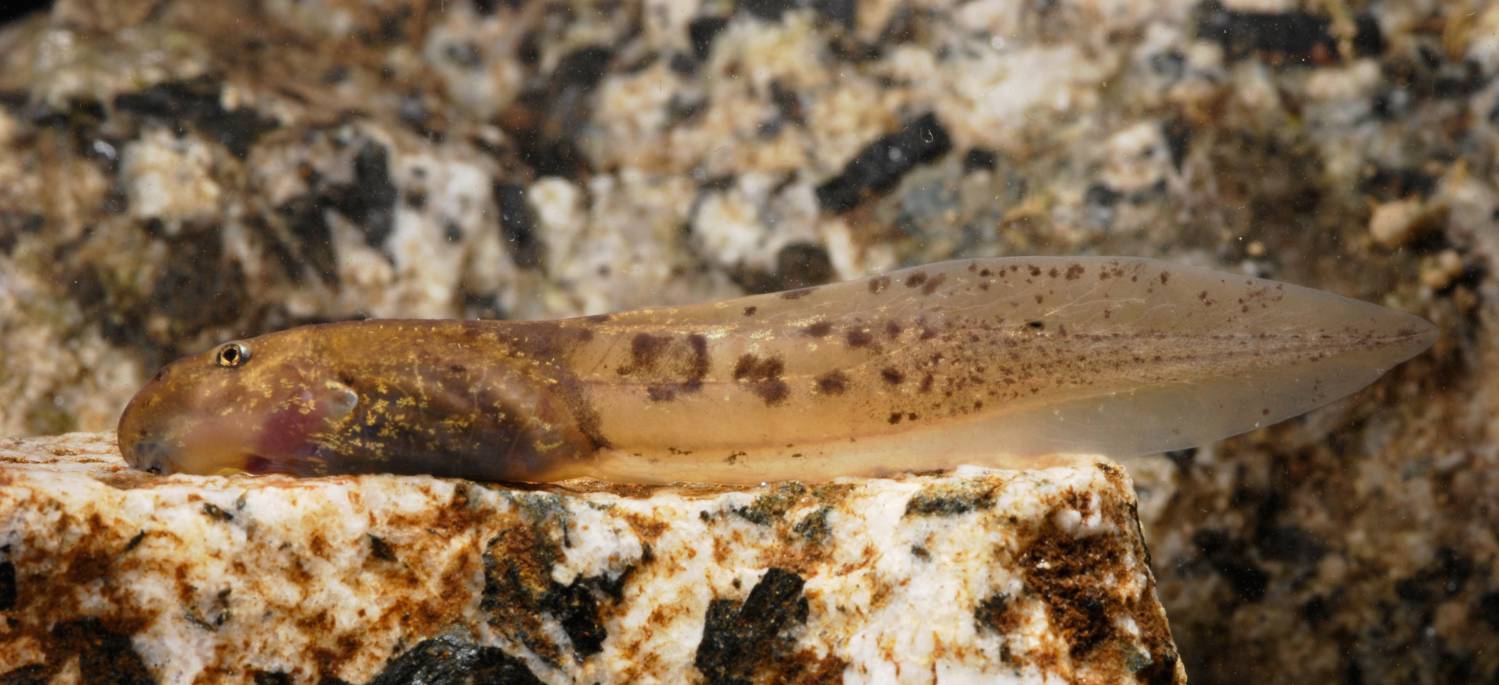
Coloration varies with developmental stage, with advanced tadpoles being darker than early stages. Dorsally, tadpoles are generally gray to brown with irregular dark markings. Distinct dark blotches are present dorsally at the tail root, although these become less conspicuous in advanced stages. Early stages show a pair of whitish structures in the posterior head region. Scattered groups of iridophores occur dorsally and, to a lesser extent, ventrally. In close-up view, a hatched pattern of pigment cells is discernible. The venter is translucent to opaque, depending on developmental stage. The gut coil is visible in early stages but becomes less apparent in advanced stages. In life, the abdominal skin exhibits a bluish-silvery iridescence, which is absent in preserved specimens. The buccal and gular regions are mostly translucent with moderate pigmentation; the gills and heart are visible and red. Body coloration extends onto the muscular portion of the tail, where it transforms into a pattern of blotches and spots. Both the muscular and fin portions of the tail bear blotches and spots. Myosepta, the lateral line, and the lateral tail vein are visible.
Snout
The snout is broadly rounded in dorsal view, blunt to somewhat obtuse at the tip, and moderately long. The region anterior to the level of the nostrils is weakly set off in dorsal view. In lateral view, the head slopes smoothly downward, and the snout is rounded. In profile, the nostril is slightly elevated.
Oral Disc
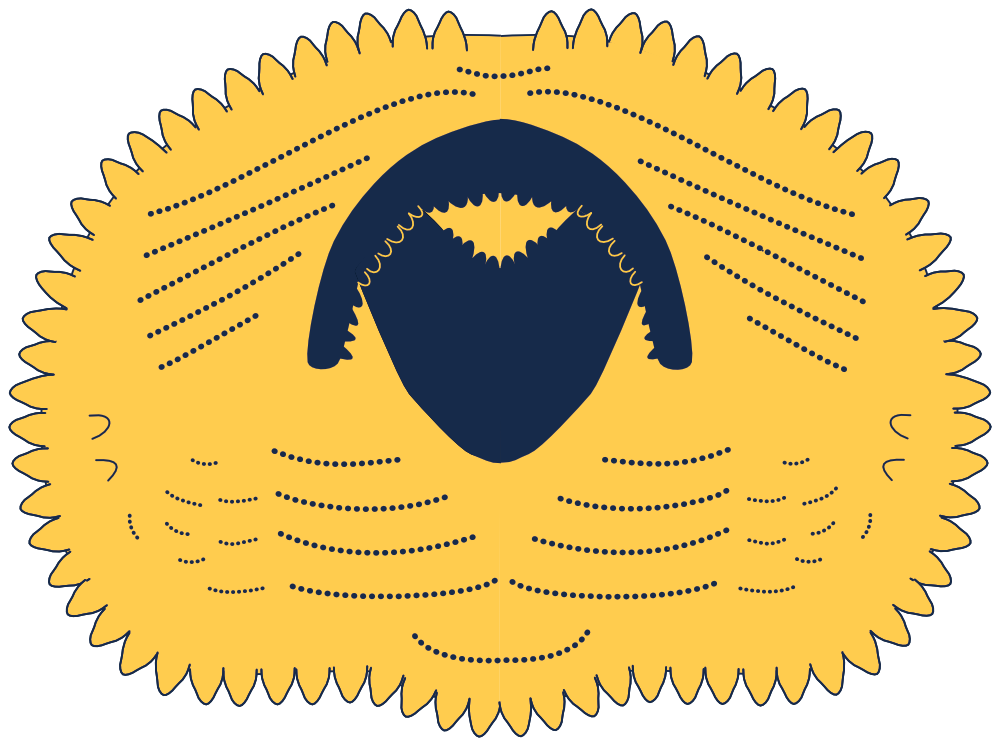
The oral disc is anteroventral to almost ventral in position and less than half the body width. There is no distinct emargination between the upper and lower lips. Both lips bear relatively large, bluntly conical marginal papillae arranged in a single row. The marginal papillation is nearly continuous, with only a small medial gap in the upper lip. The lower lip bears a few scattered submarginal papillae, some of which form short ridges bearing short keratodont rows. The keratodont formula is LTRF 6(2–6)/5(1–4). In addition, 7–10 short keratodont rows are present in the submarginal area of the lower lip. The first upper keratodont row is particularly short. The jaw sheaths are massive, well keratinized, black, and bear coarse serrations along their edges.
Body
The body is large. In lateral view, the head and trunk are slightly dorsoventrally depressed. In dorsal view, the body is elongate-oval in shape and much wider than the base of the tail. The body reaches its maximum width at the anterior trunk or posterior gill chamber. The spiracle is sinistral and opens posterolaterally. The spiracular orifice is positioned approximately at mid-body level in lateral view; its rim may be free, forming a very short tube, or fused to the body wall. Lateral line organs are distinct and appear as a series of light dashes. Myosepta are indistinct. The lateral tail vein is mostly visible.
Eyes & Nostrils
The eyes are dorsolateral and relatively small. The iris and sclera are black and densely scattered with silvery or golden iridophores. The nostril is distinct and relatively large, positioned closer to the snout than to the eye and oriented anterolaterally. The dorsal rim of the nostril forms an inconspicuous projection bulging laterally.
Tail
The tail is long, comprising 64–67% of the total length. The muscular portion is strong and, in lateral view, nearly as high as the body. The upper fin rises gradually from the trunk-tail junction, ascending relatively straight to mid-tail, where it curves weakly and then runs posteriorly in a shallow arch to a narrowly rounded tip. The lower fin originates at the trunk-tail junction and is low and shallowly arched. Maximum height of the tail and tail fins is reached at approximately mid-tail. The upper fin is higher than the lower fin. Skin glands are absent.
Similar Species
If the habitat elevation is sufficiently high to exclude Leptobrachium montanum, tadpoles of L. gunungense are readily recognized by their size and color pattern. Papillation and keratodont arrangement clearly separate them from tadpoles of other genera. However, reliable diagnostic characters that consistently distinguish L. gunungense from L. montanum have not yet been established. See comments under L. montanum.
Literature
Males call from the ground at some distance from the streams from the slopes of the stream banks. The call has been described as a series (4–16) of relatively stifled, nasal notes, higher than in the similar and sometimes sympatric L. montanum. Males stimulate each other and choruses can form temporarily.
Inger, R.F., Stuebing, R.B., Grafe, T.U., Dehling, J.M. (2017) A field guide to the frogs of Borneo. 3rd ed. Natural History Books, Kota Kinabalu. 228 pp.
Malkmus, R., Manthey, U., Vogel, G., Hoffmann, P., Kosuch, J. (2002) Amphibians & Reptiles of Mount Kinabalu (North Borneo). Koeltz Scientific Books, Königstein. 424 pp.
Malkmus, R. (1996) Leptobrachium gunungense sp. n. (Anura: Pelobatidae) vom Mount Kinabalu, Nord-Borneo. Mitteilungen aus dem Zoologischen Museum in Berlin 72: 297–301.
Malkmus, R., Manthey, U., Vogel, G., Hoffmann, P., Kosuch, J. (2002) Amphibians & Reptiles of Mount Kinabalu (North Borneo). Koeltz Scientific Books, Königstein. 424 pp.
Malkmus, R. (1996) Leptobrachium gunungense sp. n. (Anura: Pelobatidae) vom Mount Kinabalu, Nord-Borneo. Mitteilungen aus dem Zoologischen Museum in Berlin 72: 297–301.