Zum Hauptinhalt springen

Frogs of Borneo

Frogs of Borneo

Frogs of Borneo

Frogs of Borneo

Frogs of Borneo

Frogs of Borneo

Frogs of Borneo

Frogs of Borneo

Frogs of Borneo

Frogs of Borneo

Frogs of Borneo

Metaphrynella sundana

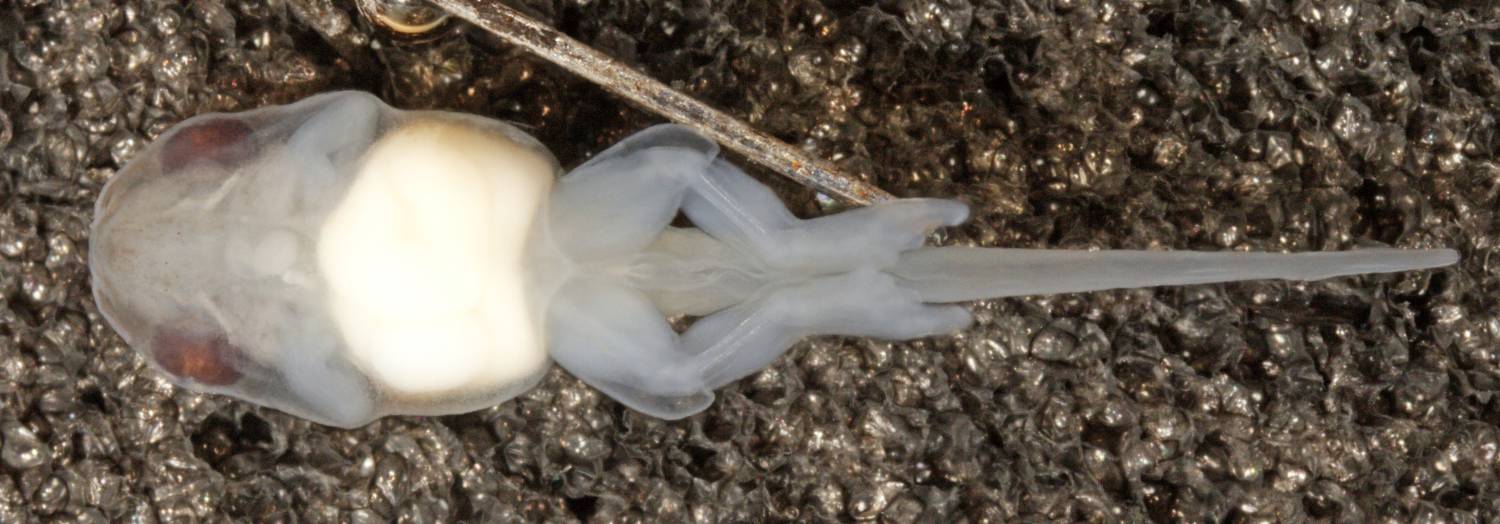
Metaphrynella sundana tadpoles live in phytotelmata such as tree holes or accessible bamboo internodes. The tadpoles do not feed but live off the yolk mass contained in their gut.
  • Family:
    Microhylidae
  • Genus:
    Metaphrynella
  • Ecomorph:
    endotrophic, phytotelma specialist
  • Waterbody Type:
    phytotelma
  • Water Column:
  • Feeding Type:
    non-feeding
  • Size:
    9 mm
  • Development:
    larva, tadpole
  • Adult:
    Metaphrynella

Coloration

Uniformly brown above in preservation, without pattern, and overall only lightly pigmented. Pigmentation of the body continues onto the tail and tail fins but quickly fades in the posterior and ventral parts of the tail. The density of melanocytes declines ventrally along the flanks. The ventral side is unpigmented and transparent. The gut coil and heart are visible in ventral view.

Snout

Very short, bluntly rounded, with a truncated tip in lateral view. In dorsal view, broadly rounded and medially truncated.

Oral Disc

Mouth terminal; oral disc absent. Mouth small, with a shallowly arched upper jaw and a wide, flat U-shaped lower jaw. Keratinized jaw sheaths and keratodonts absent; LTRF (0/0).

Body

Very small in overall size. Head and trunk only slightly depressed dorsoventrally. In dorsal view, the head is smoothly confluent with the trunk. In lateral view, the head is bluntly rounded anteriorly, the snout very short. The trunk is broadly rounded posteriorly and wider than the base of the tail. Body widest at the head-trunk transition. Spiracle ventral and medial, in a mid-belly position. Spiracular orifice opens posteriorly without flaps, forming a shallow arch.

Eyes & Nostrils

Eyes relatively large and positioned laterally; the cornea protrudes beyond the body contour in dorsal and ventral views. Nostril not perforated in larval stages.

Tail

Approximately 67% of total length. Muscular part of the tail moderately developed, approximately half of body height in lateral view and less than half of trunk width in dorsal view. Upper fin originates on the very posterior part of the trunk. It remains low for a short distance and then rises into a shallow convex arch. Both fins are subequal in height and symmetrical. Tail tip moderately to broadly rounded. Skin glands absent. Lateral tail vein indistinct. Muscle myosepta indistinct.

Similar Species

Microhyla nepenthicola, species of Kalophrynus, species of Pelophryne, and Metaphrynella sundana all breed and develop in phytotelmata and have endotrophic tadpoles. In a given field situation, these taxa can be confused due to their phytotelma habitat and miniature size. Among them, Pelophryne possesses a small oral disc with few keratodonts. Microhyla nepenthicola is diagnosed by its cuspidate tail tip. Metaphrynella and Kalophrynus are more difficult to differentiate. In fact, no morphological feature can be named that reliably separates them prior to metamorphic stages, when broadly expanded toe and finger tips become apparent in Metaphrynella (not expanded in Kalophrynus). The tadpole of Chaperina fusca is also a relatively small phytotelma larva; however, it is approximately twice as large as the aforementioned taxa, is exotrophic, and possesses a comparatively large head.

Literature

Males call from phytotelmata, such as treeholes or bamboo internodes, and exploit the resonance acoustic properties of the cavities by tuning the call pitch and duration to the resonance of the chamber for maximum resultant sound pressure. The call is a single pulse with little or no frequency modulation at 2–18 s intervals.
Lardner, B., bin Lakim, M. (2002) Treehole frogs exploit resonance effects. Nature 420: 475–475.

Matsui, M., Yong, H.S., Araya, K., Hamid, A.A. (1996) Acoustic characteristics and systematic relationships of arboreal microhylid frogs of the genus Metaphrynella from Malaysia. Journal of Herpetology 30: 424–427.