Frogs of Borneo

Frogs of Borneo

Frogs of Borneo

Frogs of Borneo

Frogs of Borneo

Frogs of Borneo

Frogs of Borneo

Frogs of Borneo

Frogs of Borneo

Frogs of Borneo

Frogs of Borneo
Filter
Microhyla nepenthicola
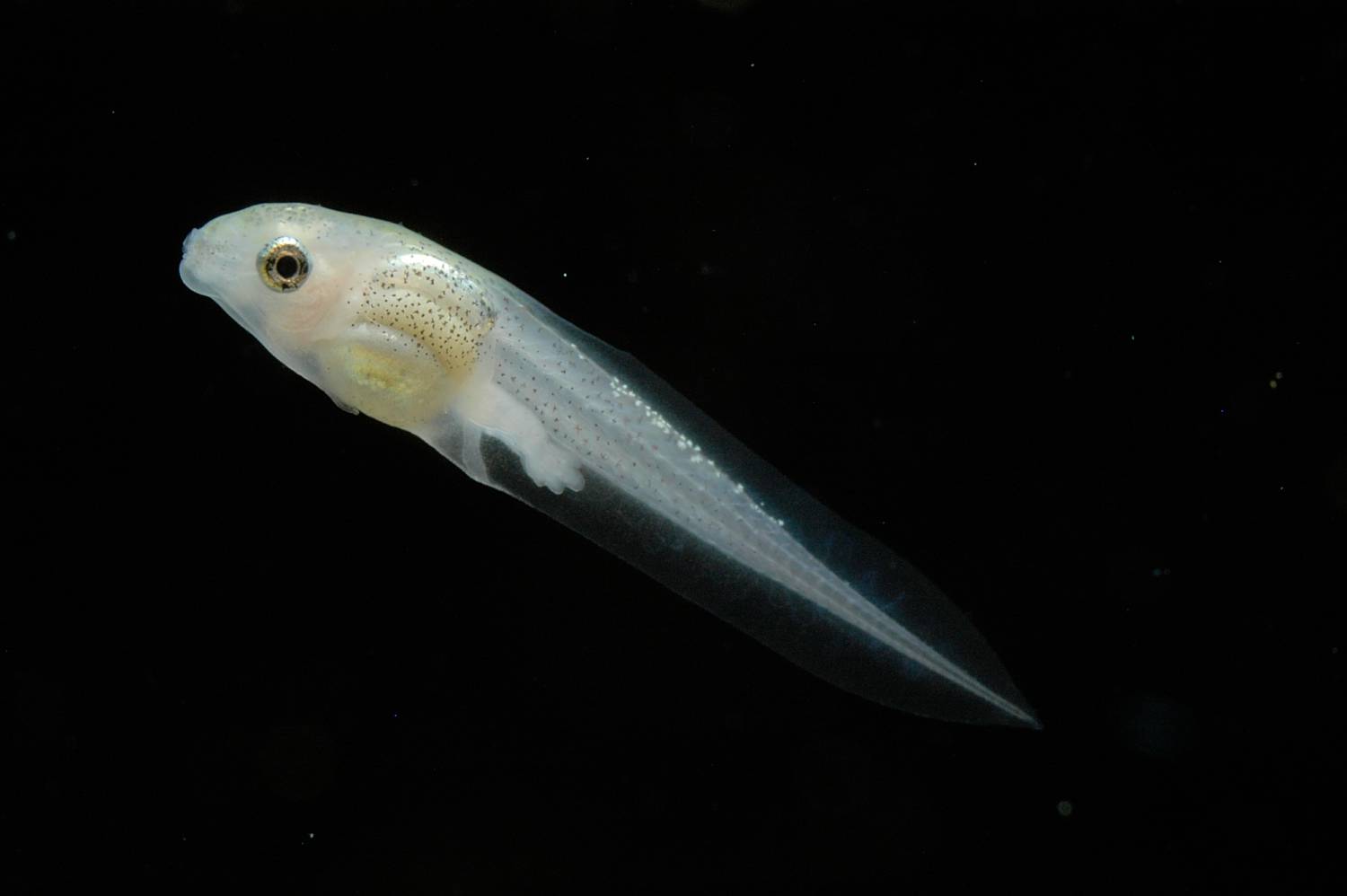
Tadpoles of Microhyla nepenthicola hover almost motionless in the small water pools inside Nepenthes pitchers. Their short, flagellate tail tip is continuously beating, maintaining position in the confined water volume. The body axis is oriented at approximately 35° with the head directed upward. The tadpoles do not feed and rely entirely on endogenous reserves. Up to 14 larvae at different developmental stages were found within a single pitcher, indicating repeated oviposition events in the same phytotelma. When disturbed, tadpoles perform rapid swimming bursts and retreat into the accumulated debris at the bottom of the pitcher.
-
Family:Microhylidae
-
Genus:Microhyla
-
Ecomorph:endotrophic, phytotelma specialist
-
Waterbody Type:phytotelma
-
Water Column:—
-
Feeding Type:non-feeding
-
Size:11 mm
-
Development:larva, tadpole
-
Adult:Microhyla
Coloration
Dorsally, gray to olive hues dominate on an otherwise transparent background; no distinct color pattern is present. Melanocytes are scattered across the dorsal surface of the head, trunk, flanks, and muscular part of the tail. Silver to golden iridophores are sparsely distributed on the posterior trunk and dorsal surface of the tail musculature. Ventral skin transparent and devoid of pigment cells; internal organs visible, especially the red heart, yellow gut, and silvery lung dorsally. Tail fins transparent.
Snout
Very short and broadly rounded in dorsal view, with a shallow anterior bay accommodating the reduced mouthparts. In lateral view, the snout tip appears truncated, with a distinct ventral bulge forming a pronounced “chin”. Jaws slightly recessed.
Oral Disc
Mouth terminal and slightly directed upward in lateral view. Upper lip of the oral disc almost completely reduced. Lower lip strongly reduced but present as a small flap bearing a few papillae immediately inside the lip margin. Curved lateral bulges present at the corners of the mouth. The snout surrounding the mouth bulges slightly, giving the impression that the mouth is recessed within a shallow horizontal depression at the snout tip. Jaw edges lack black keratinization; keratodonts absent; LTRF 0/0.
Body
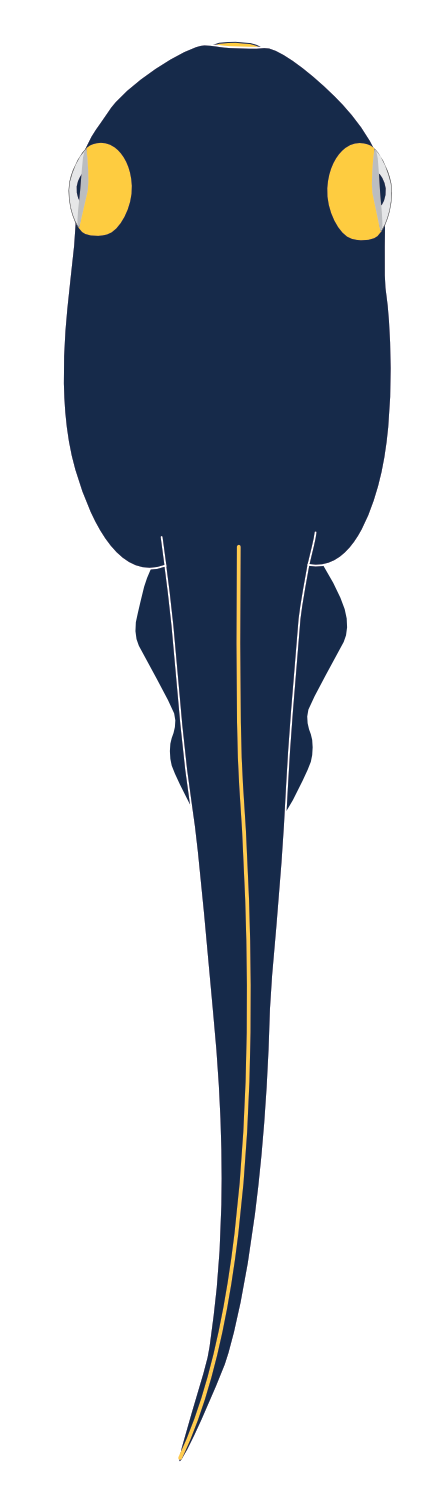
Very small overall size. Head and trunk not noticeably dorsoventrally depressed. Trunk approximately as wide as high. Head rounded dorsally in lateral view. In dorsal view, head and trunk smoothly oblong. Head less dominant relative to trunk than in exotrophic microhylid tadpoles. Head nearly as wide as the trunk. Trunk broadly rounded posteriorly. Body widest at the trunk region and distinctly wider than the base of the tail. Spiracular orifice ventral, median, and located approximately at the midpoint of the abdomen; opening posteriorly. Ventral rim of spiracle bears a flap-like extension shaped as a truncated V. Lateral line organs and lateral tail vein not visible.
Eyes & Nostrils
Eyes large relative to body size, widely spaced, and positioned laterally. Cornea protrudes beyond the body contour in both dorsal and ventral views. Iris dusted with dense bronze pigmentation on a black background. Scleral portion of the eyeball covered with reflective iridocytes, appearing silvery to golden depending on light direction and intensity. Nostrils not perforated in larval stages.
Tail
Approximately 67% of total length. Tail moderately developed, about half the trunk width in dorsal view. Muscular part of the tail lower than body height in lateral view. Upper fin originates at the trunk-tail junction. Upper fin contour largely straight, with noticeable convexity only in the distal third of the tail. Lower fin similar in shape and as high as or slightly higher than the upper fin. Tail tip cuspidate, forming a short flagellum. Skin glands absent. Lateral tail vein invisible. Muscle myosepta faintly visible under magnification.
Similar Species
The combination of phytotelm specialization, exclusive association with Nepenthes pitchers, extremely small size even at advanced developmental stages, hovering behavior, absence of a color pattern, and cuspidate tail tip renders these tadpoles highly distinctive and unlikely to be confused with any other larvae in the field. Microhyla malang, a close relative on Borneo, differs clearly in its larger size, longer flagellate tail tip, and more developed oral disc. Microhyla borneensis is presumed to possess similar larvae, but this remains to be confirmed.
Literature
Males are found calling from the forest floor in the vicinity of pitcher plants. Amplecting pairs crawl into the pitcher and lay only a few large, yolkrich eggs. Although pitcher plants are preferred, some other small phytotelmata near the forest floor may be used. Development is fast and culminates with a metamorphosis only two weeks after egg deposition. Despite their miniature size of only 3.5 mm, the metamorphosed froglets are powerful jumpers and manage to jump out of the pitcher.
Das, I., Haas, A. (2010) New species of Microhyla from Sarawak: Old World's smallest frogs crawl out of miniature pitcher plants on Borneo (Amphibia: Anura: Microhylidae). Zootaxa 2571: 37–52.
Gorin, V.A., Solovyeva, E.N., Hasan, M., Okamiya, H., Karunarathna, D.M.S.S., Pawangkhanant, P., Silva, A. de, Juthong, W., Milto, K.D., Nguyen, L.T., Suwannapoom, C., Haas, A., Bickford, D.P., Das, I., Poyarkov, N.A. (2020) A little frog leaps a long way: compounded colonizations of the Indian Subcontinent discovered in the tiny Oriental frog genus Microhyla (Amphibia: Microhylidae). PeerJ 8, e9411–47.