Frogs of Borneo

Frogs of Borneo

Frogs of Borneo

Frogs of Borneo

Frogs of Borneo

Frogs of Borneo

Frogs of Borneo

Frogs of Borneo

Frogs of Borneo

Frogs of Borneo

Frogs of Borneo
Filter
Microhyla petrigena
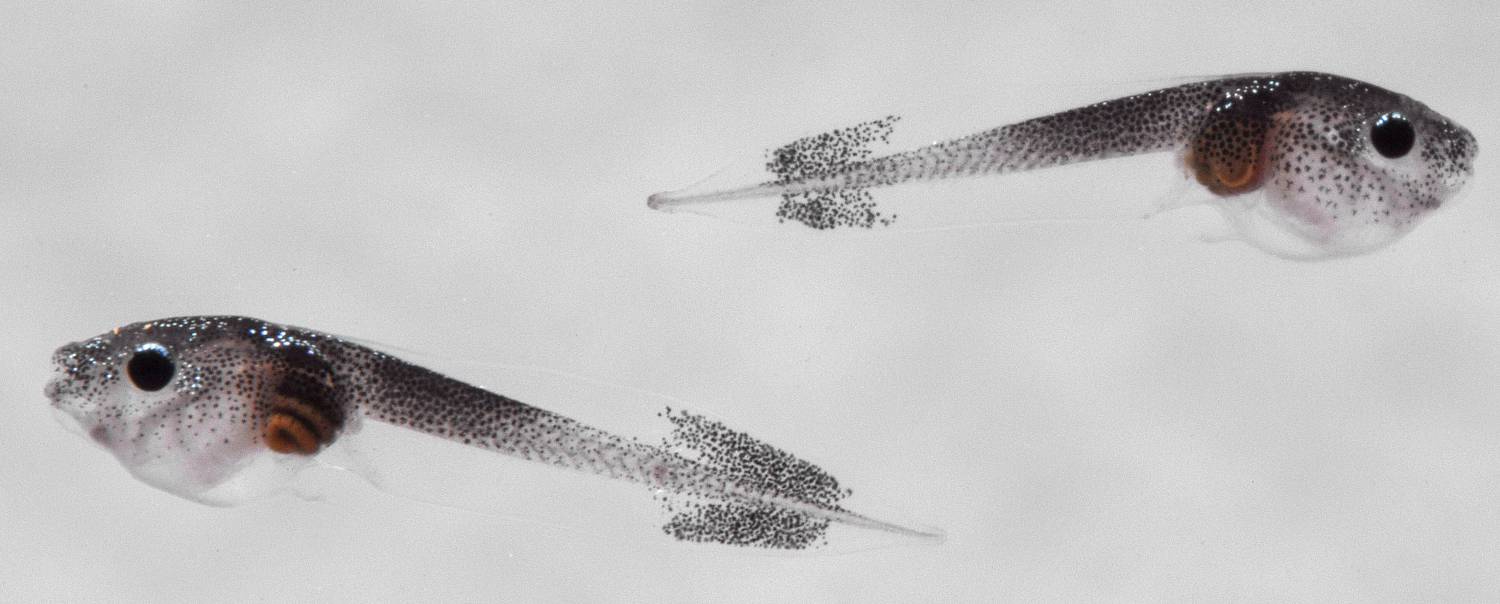
The tadpoles of Microhyla petrigena have exclusively been found in potholes or rock troughs in and along rocky streams. The tadpoles are obligate suspension feeders; they filter microscopic particles from the water that they pump through their branchial filter system. They can be seen suspension feeding near the water surface with slow swimming motions. As is typical for many suspension feeders that feed at various levels in the water column, M. petrigena larvae maintain their position by constantly beating their tail tip.
-
Family:Microhylidae
-
Genus:Microhyla
-
Ecomorph:exotrophic, lentic
-
Waterbody Type:stagnant
-
Water Column:mid-water to surface
-
Feeding Type:feeding, suspension feeder
-
Size:16 mm
-
Development:larva, tadpole
-
Adult:Microhyla
Coloration
Head, trunk, and proximal part of tail brown above. The muscular part of the tail is dark brown to black laterally for one third to half of the tail and fades distally. A broad black vertical band runs across the tail at approximately 66% of the tail length. Apart from the band, the tail fins are clear. Anterior to the black band, there are scattered iridophores along the dorsal and ventral edges of the muscular tail part. Scattered iridophores are furthermore present dorsally on the trunk and on the dorsal and lateral faces of the head. Ventral skin transparent, without pigmentation; the inner organs are visible, especially the gut.
Snout
Moderately long, broadly rounded, slightly truncated in dorsal view. In lateral view, moderately tapering, tip truncated, with a bulging “chin.” Jaws recessed.
Oral Disc
Mouth terminal. Oral disc absent. Upper jaw wide and straight, overhanging lower jaw substantially; lower jaw U-shaped and deeply recessed. Chin-like soft tissue bulge below mouth. Mouth opening recessed in a horizontal depression. No keratinization (beaks) on jawlines. Keratodonts absent; LTRF (0/0).
Body
Small in overall size. Head very large in comparison to trunk. In dorsal view, head-to-trunk transition distinctly visible as a narrowing of the body. Head as broad as long in dorsal view; flat above. Body widest at the posterior end of the gill region of head. Trunk short, broadly rounded posteriorly. Trunk significantly wider than base of tail in dorsal view. Spiracular orifice ventral and located medially, slightly posterior to the center of the abdomen. Spiracle opening posteriorly and extended by a ventral flap; posterior edge of flap fringed with finger-like projections. Lateral line organs not visible.
Eyes & Nostrils
Eyes relatively large, widely spaced, and positioned laterally. Eye cornea protruding beyond body contour in dorsal and ventral views. Iris black with scattered silver-gold iridophores dorsal and ventral to pupil. Scleral part of eyeball with scattered silver iridophores dorsally. Nostril not perforated in larval stages.
Tail
Up to 65–67% of total length. Tail musculature narrow, less than half the width of trunk in dorsal view and less than half the depth of body in lateral view. Upper fin originates at trunk-tail junction. Upper fin contour only shallowly convex (in the middle part of tail). Lower fin similar in shape and equal in height. Both fins taper in the posterior third of tail, forming a narrowly rounded tip. Tip slightly flagellate, i.e., a mild concavity in contour present terminally. Skin glands absent. Lateral tail vein invisible. Muscle myosepta indistinct.
Similar Species
A combination of larval characters clearly diagnoses Microhyla petrigena as microhylid and separates it from all other Bornean families: terminal mouth, reduced oral disc, and ventromedian spiracular opening. M. petrigena larvae can be confused with Microhyla malang or M. perparva tadpoles that also live in standing bodies of water. M. petrigena and M. perparva are distinguished from M. malang by smaller size, broader head, shorter flagellum, complete lack of oral disc, and lack of conspicuous white flecks above. Tadpoles of M. petrigena and M. perparva seem indistinguishable on the basis of the samples analyzed. The tail band seemed slightly more distal and the tail tip more abruptly flagellate in the few M. perparva we could compare to M. petrigena. This may, however, overlap with intraspecific variation or phenotypic plasticity in the two species. The two species are most clearly separated ecologically in that M. perparva larvae populate temporary forest ponds and water-filled depressions of the forest floor, whereas M. petrigena is associated with rocky streams where the tadpoles live in rock pools.
Literature
Males call from around suitable rock pools along the shores of clear, rocky forest streams. Eggs are small, black and float as a single layer in a perfectly transparent jelly mass on the water surface, usually sticking with one of the sides to a rock. Details of development have not been documented, but the larval period is suspected to be short.
Inger, R.F. (1985) Tadpoles of the forested regions of Borneo. Fieldiana Zoology new series 26: 1–89.
Inger, R.F., Stuebing, R.B., Grafe, T.U., Dehling, J.M. (2017) A field guide to the frogs of Borneo. 3rd ed. Natural History Books, Kota Kinabalu. 228 pp.