Zum Hauptinhalt springen

Frogs of Borneo

Frogs of Borneo

Frogs of Borneo

Frogs of Borneo

Frogs of Borneo

Frogs of Borneo

Frogs of Borneo

Frogs of Borneo

Frogs of Borneo

Frogs of Borneo

Frogs of Borneo

Microhyla sundaica

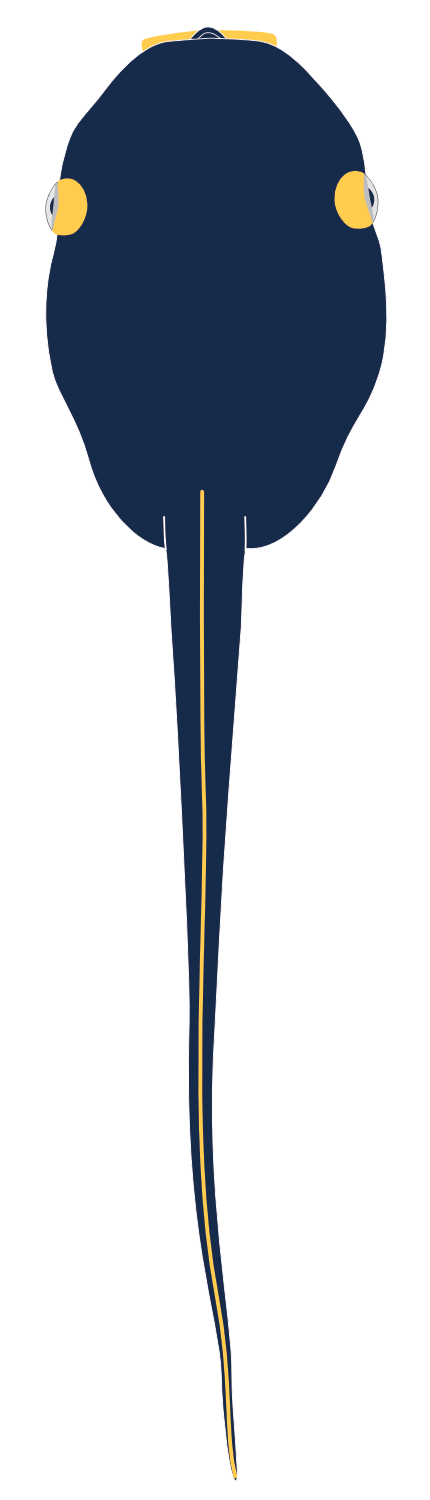
Microhyla berdmorei tadpoles inhabit temporary stagnant pools, drainages, or flooded areas, where they filter the water for microscopic particles, often at mid-water level or near the surface. These larvae are highly efficient suspension feeders.
  • Family:
    Microhylidae
  • Genus:
    Microhyla
  • Ecomorph:
    endotrophic, lentic, suspension feeder
  • Waterbody Type:
    stagnant
  • Water Column:
    mid-water to surface
  • Feeding Type:
    feeding, suspension feeder
  • Size:
    23 mm
  • Development:
    larva, tadpole
  • Adult:
    Microhyla

Coloration

Overall mostly yellowish, with body skin largely transparent. Fins mostly clear. Ventral side transparent and unpigmented; internal organs visible.

Snout

Snout moderately long and rounded. Tip of snout truncated in lateral view, with a bulging “chin”.

Oral Disc

Mouth terminal. Oral disc present but reduced. Lower jaw present as a distinct U-shaped arch. Jaw edges not noticeably keratinized (not black), and keratodonts absent; LTRF (0/0).

Body

Small in overall size. Body broadly elliptical, flat dorsally. Head dominates the body and is longer and wider than the trunk. Body widest at the posterior gill region of the head. Trunk rounded in cross section. Spiracular orifice ventral and medial, opening below the posterior abdomen. Spiracle opens posteriorly and bears a ventral, flap-like extension; edge of flap smoothly convex, not crenulated. Lateral line organs not visible.

Eyes & Nostrils

Eyes relatively large, widely spaced, and positioned laterally; cornea protruding beyond body contour in dorsal and ventral views. Iris dusted with dense metallic pigmentation on a black background; scleral part of the eyeball also covered with reflecting iridocytes. Nostril not perforated in larval stages.

Tail

Up to approximately 69% of total length. Tail muscle moderately developed and narrow; less than half the width of the trunk in dorsal view. Muscular part of the tail approximately half the depth of the body in lateral view. Upper fin originates slightly anterior to the trunk-tail junction on the trunk; its contour mostly straight, with shallow convexity only in the middle third of the tail. Lower fin similar in shape but higher than the upper fin, particularly in the proximal half of the tail. In the posterior fourth of the tail, fins taper toward a narrowly rounded tip, without forming a distinct flagellum. Skin glands absent. Lateral tail vein invisible. Muscle myosepta faintly visible under magnification.

Similar Species

Microhyla berdmorei tadpoles are easily diagnosable as microhylid tadpoles by their lack of keratinized mouthparts, reduced oral disc, terminal mouth, and ventromedian spiracle. In comparison, Microhyla petrigena, M. perparva, and Microhyla malang possess distinctive color pattern features, particularly on their tails, and are smaller in size than M. berdmorei. Glyphoglossus tadpoles differ from M. berdmorei by tail fin shape, with a higher lower fin relative to the upper fin.

Reproduction

Inger et al. (2017) reported the advertisement call as a short rasping pulse with dominant frequencies between 1500–1800 Hz.

Literature

Inger et al. (2017) reported the advertisement call as a short rasping pulse with dominant frequencies between 1500–1800 Hz.