Zum Hauptinhalt springen

Frogs of Borneo

Frogs of Borneo

Frogs of Borneo

Frogs of Borneo

Frogs of Borneo

Frogs of Borneo

Frogs of Borneo

Frogs of Borneo

Frogs of Borneo

Frogs of Borneo

Frogs of Borneo

Occidozyga berbeza

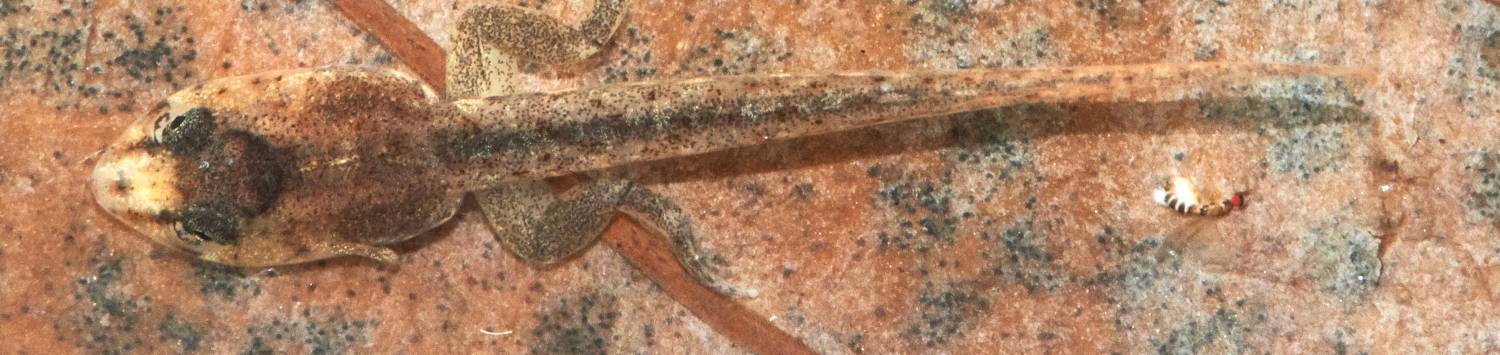
Occidozyga berbeza tadpoles share the general larval morphology with other Occidozyga. It is likely that O. berbeza tadpoles are obligate carnivores with an ecology similar to tadpoles of O. baluensis (see comments there). Tadpoles can live in a very shallow film of water.
  • Family:
    Dicroglossidae
  • Genus:
    Occidozyga
  • Ecomorph:
    benthic, exotrophic, lentic
  • Waterbody Type:
    stagnant
  • Water Column:
    bottom
  • Feeding Type:
    feeding
  • Size:
    22 mm
  • Development:
    larva, tadpole
  • Adult:
    Occidozyga

Coloration

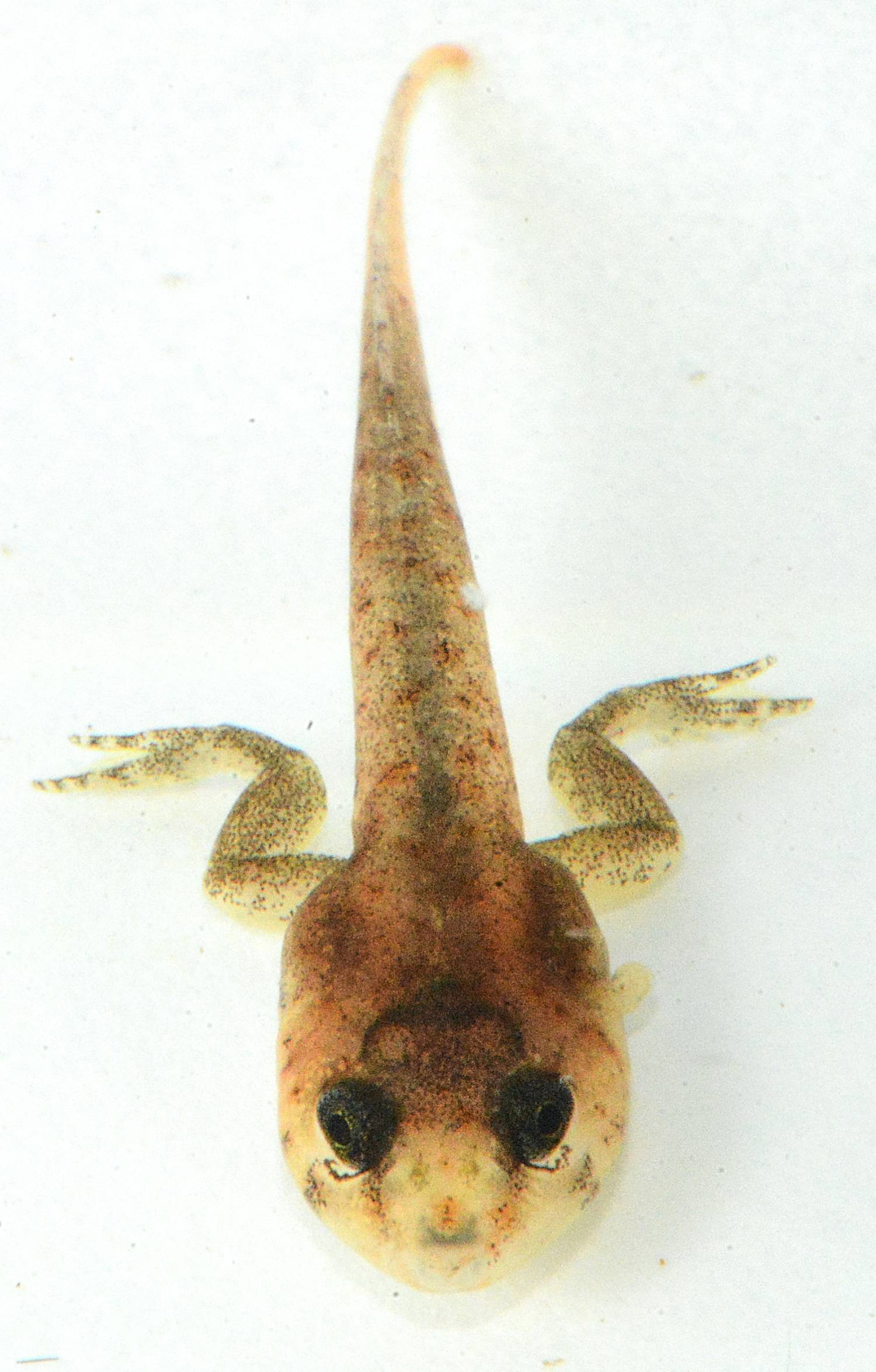
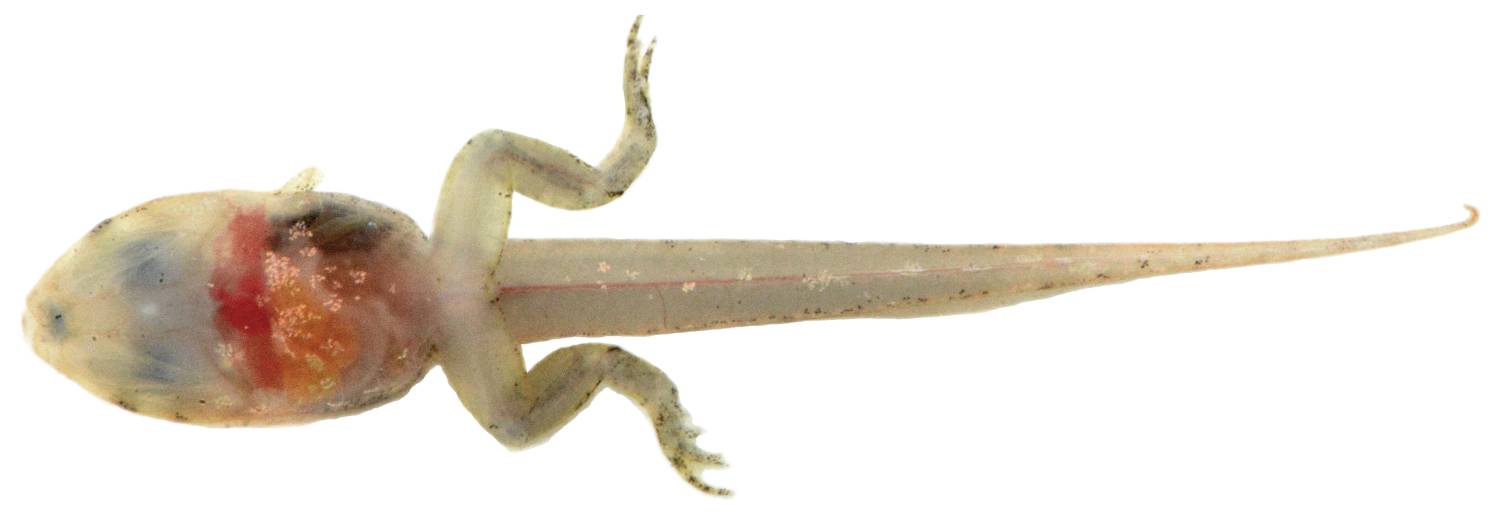
Brown above, with irregular blurred darker flecks on dorsum and dorsal tail. Large dark area between eyes and extending back to occipital region. A light cream patch dorsally on snout bordered by darker areas laterally. Head and trunk densely dusted with iridocytes; scattered dark melanocytes (dots), particularly at the lateral face. Orbital space anterior to eye unpigmented. Flanks darker than dorsum. Skin of venter mostly unpigmented and transparent, except for scattered iridocytes at anterior abdominal and gill areas. Inner organs visible through skin, especially a large orange liver and red gills. General color of tail similar to that of body, dark above and lighter on the sides. Black dots (melanocytes) scattered over tail, with some cells congregating in many small clusters along tail. Similarly, many small clusters of whitish to cream iridocytes distributed over tail. Pigmentation of tail extends onto tail fins.

Snout

In dorsal view, tapering towards a truncate tip; snout forms a medial bulge that overhangs the mouth tube. In lateral view, snout moderately long and contour tapering straight into an obtuse tip.

Oral Disc

Mouth terminal in position; oral disc and lip flaps absent; a horseshoe-like short tube (open dorsally) formed instead. This mouth structure positioned in a recess of the snout, so that the mouthparts do not protrude beyond the body silhouette in dorsal view. Papillae and keratodont rows absent. LTRF 0/0. Jaws well developed and keratinized but recessed far backward from external mouth orifice.

Body

Medium-sized. In dorsal view, general body contour oblong oval; however, head slightly wider and longer than trunk and tapering anteriorly. Body widest at level of posterior head region (gill region). Head contour smoothly rounded in dorsal view, except for truncation at snout. Body depressed dorsoventrally. Spiracle sinistral and opening posteriorly. Due to large head, spiracle located in a posterior position. Medial side of spiracle not attached to body wall, and spiracular orifice at end of a long free tube. Spiracle below mid-body level in lateral view. Lateral line organs indistinct. Hindlimbs developed precociously.

Eyes & Nostrils

Eyes relatively large and positioned dorsolaterally. Eye axis oriented anterolaterally, with a significant overlap in field of view of the two eyes, presumably producing stereoscopic vision. Iris and orbit of eye beyond iris dotted with silver-brass iridocytes. Nostril opening absent for most of larval life.

Tail

Very long, up to 75% of total length. Muscular part of tail strong. In dorsal view, tail muscle more than half maximum trunk width, nearly as high as trunk in lateral view. Upper and lower fins both originate far posterior to trunk-tail junction at approximately 40% of tail length. Upper fin higher than lower fin. Both fins very low, with little convexity in contour line. In posterior fourth of tail, fins converge into an acute or narrowly rounded tip. Maximum tail height approximately at beginning of distal third of tail. Lateral tail vein and tail myosepta indistinct.

Similar Species

Tadpoles of the genus Occidozyga are easily recognized by their hind limbs, long tail, and peculiar mouthparts. Diagnostic characters that distinguish the three species described here have not been corroborated by larger samples. Additional undescribed species occur on the island of Borneo. However, the preliminary results presented here suggest that potential larval diagnostic features within the genus could be the mouthparts (recessed vs. protruding), the length of the snout, the shape of the snout in lateral view, the angle of eye axis (more anteriorly directed in O. baluensis and O. berbeza than in O. aff. laevis), and the position of the fin origins along the length of the tail.

Literature

The frogs were found in shallow puddles and seepage areas where reproduction seems to occur.
Flury, J.M., Haas, A., Brown, R.M., Das, I., Pui, Y.M., BoonHee, K., Scheidt, U., Iskandar, D.T., Jankowski, A., Hertwig, S.T. (2021) Unexpectedly high levels of lineage diversity in Sundaland puddle frogs (Dicroglossidae: Occidozyga Kuhl and van Hasselt, 1822). Molecular Phylogenetics and Evolution 163: 107210.

Matsui, M., Nishikawa, K., Eto, K., Hamidy, A., Hossman, Y., Fukuyama, I. (2021) A new Occidozyga from Sarawak, Malaysian Borneo (Anura: Dicroglossidae). Zootaxa 4926: 535–546.