Zum Hauptinhalt springen

Frogs of Borneo

Frogs of Borneo

Frogs of Borneo

Frogs of Borneo

Frogs of Borneo

Frogs of Borneo

Frogs of Borneo

Frogs of Borneo

Frogs of Borneo

Frogs of Borneo

Frogs of Borneo

Phrynoidis juxtasper

Tadpoles inhabit quiet, sun-exposed, warm side pools along the shores of rocky lowland streams. They are active both day and night and feed on organic growth on rocks. Short bursts of breeding activity and development in warm streamside pools may result in rapid growth and development, which could explain why tadpoles of this otherwise common species are not frequently encountered. These assumptions, however, require confirmation through further research.
  • Family:
    Bufonidae
  • Genus:
    Phrynoidis
  • Ecomorph:
    benthic, exotrophic, lotic, suctorial
  • Waterbody Type:
    flowing
  • Water Column:
    bottom
  • Feeding Type:
    feeding, hard surface grazer, omnivorous, rasping
  • Size:
    20 mm
  • Development:
    larva, tadpole
  • Adult:
    Phrynoidis

Coloration

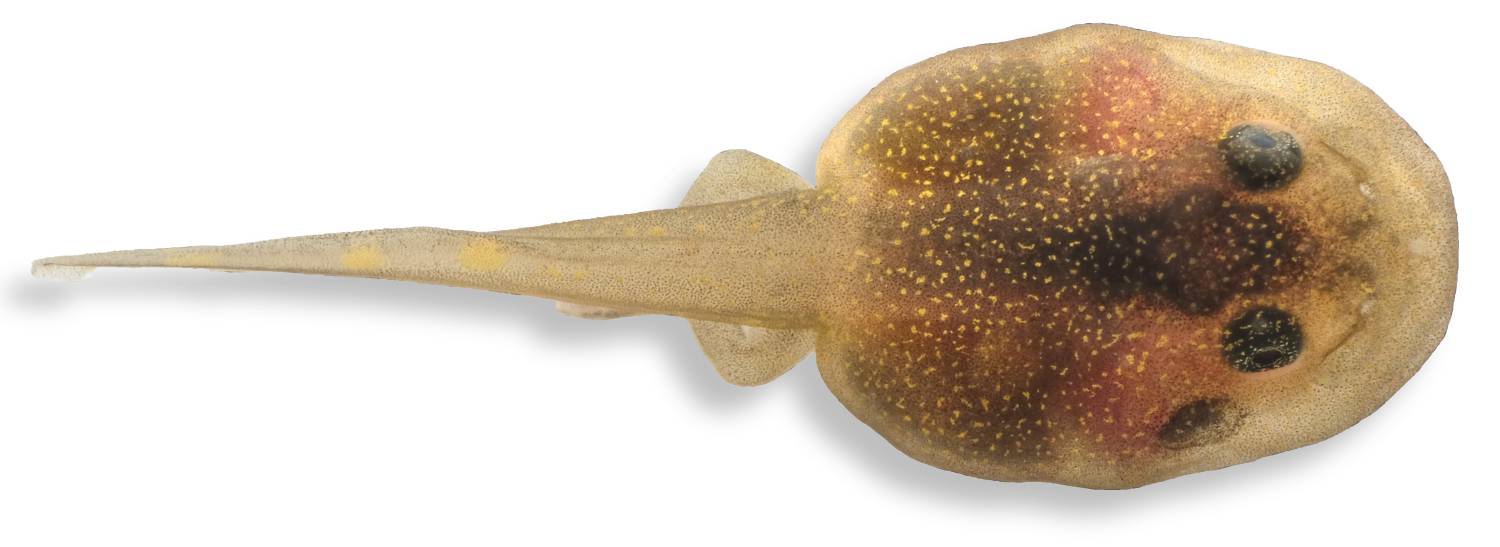
Dark brown dorsally and on the flanks; ventrally dusted with gold. Oral disc without pigmentation. Gut, gills, and heart visible through the ventral skin. Gut with a conspicuous transverse arrangement. Dark pigmentation extends from the trunk onto the muscular part of the tail; the distal third of the tail musculature is significantly darker. Large parts of the body are dusted with irregular groups of golden iridocytes, forming several larger yellowish to golden markings on the tail. Tail fins moderately pigmented but mostly clear.

Snout

Bluntly rounded in dorsal view; moderately elongated and steeply sloping in lateral view.

Oral Disc

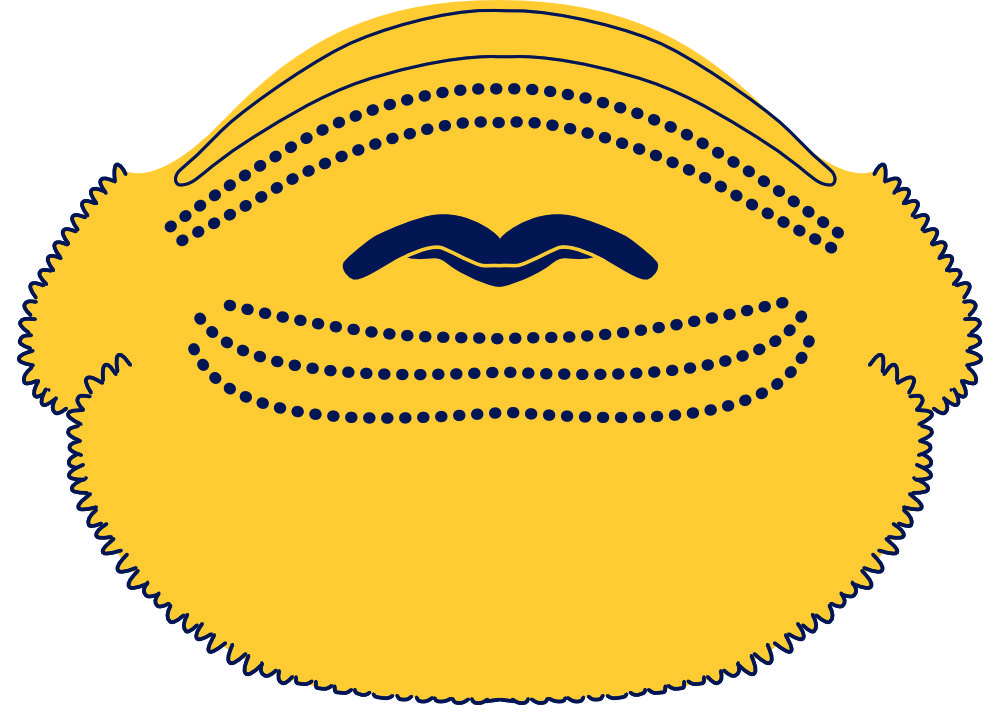
Ventral, almost as wide as the body. Two keratodont rows on the upper lip and three on the lower lip; rows undivided (LTRF 2/3) or with the anterior two rows on the lower lip divided (LTRF 2/3(1–2)). Lower lip with a uniserial row of papillae. Upper lip with papillae laterally and a fleshy rim medially where papillae are absent. Beaks moderately developed, undivided.

Body

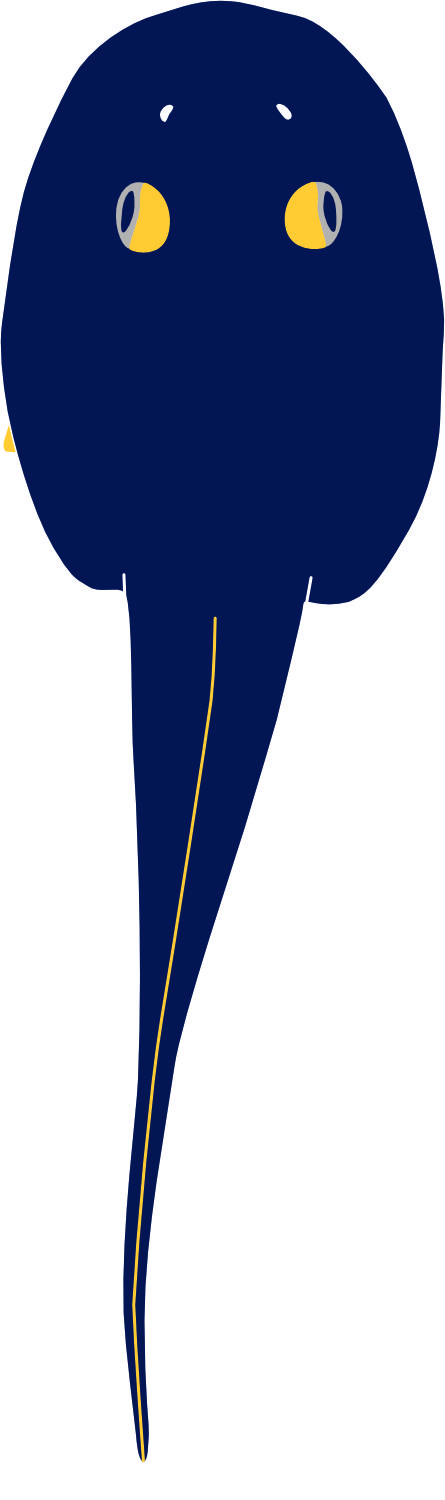
Oval, slightly dorsoventrally depressed. Spiracle sinistral, positioned below the mid-body axis in lateral view.

Eyes & Nostrils

Nostrils much closer to eyes than to tip of snout. Eyes dorsolateral.

Tail

Relatively short, less than two thirds of total length. Muscular part moderately strong, slightly more than half of body height in lateral view. Dorsal tail fin originates shortly posterior to the trunk-tail junction; it rises in a relatively straight line in the first third, then forms a smooth peak around mid-tail and curves shallowly toward a broadly rounded tip. Overall fin shape bluntly lanceolate to spatulate. Myosepta indistinct.

Similar Species

Phrynoidis juxtasper possesses a large oral sucker and dark coloration, which may lead to confusion with larvae of Ansonia. It can be distinguished by its oval head-trunk shape (vs. droplet-shaped), undivided beaks (vs. divided upper beak), and distinct ventral abdominal pattern. Despite the abundance of adult P. asper in some habitats, tadpoles are rarely encountered. Inger (1985) described the tadpole of P. asper as similar to larvae of Ingerophrynus divergens and suggested that this resemblance might have led to misidentifications. However, (1972) described a larva from Peninsular Malaysia that resembles a stream-adapted tadpole similar in size, oral disc, and tail morphology to P. juxtasper (as described here and confirmed by DNA barcoding). These discrepancies indicate that the breeding biology and larval stages of P. asper require further study.

Literature

P. juxtasper reproduce along midsize to large lowland streams with coarse gravel and rock bed. The calls of the males can be heard from far.
Berry, P.Y. (1972) Undescribed and little known tadpoles from West Malaysia. Herpetologica, 28: 338–346.

Inger, R.F. (1985) Tadpoles of the forested regions of Borneo. Fieldiana Zoology new series 26: 1–89.

Malkmus, R., Manthey, U., Vogel, G., Hoffmann, P., Kosuch, J. (2002) Amphibians & Reptiles of Mount Kinabalu (North Borneo). Koeltz Scientific Books, Königstein. 424 pp.

Manthey, U., Grossmann, W. (1997) Amphibien & Reptilien Südostasiens. Natur und Tier Verlag, Münster. 511 pp.