Zum Hauptinhalt springen

Frogs of Borneo

Frogs of Borneo

Frogs of Borneo

Frogs of Borneo

Frogs of Borneo

Frogs of Borneo

Frogs of Borneo

Frogs of Borneo

Frogs of Borneo

Frogs of Borneo

Frogs of Borneo

Sarawakiphrys dringi

Tadpoles have been observed in small, shallow pools along the margins of high-elevation streams. These pools occur at the edges of moderately flowing streams with rocky or coarse gravel substrates and are connected by steep, narrow (50–150 cm wide) fast-flowing cascades over bedrock. Tadpoles are typically encountered near the stream banks, especially among accumulations of leaf litter or coarse gravel mixed with leaves and other organic debris.
  • Family:
    Megophryidae
  • Genus:
    Megophrys
  • Ecomorph:
    exotrophic, lotic, surface feeder
  • Waterbody Type:
    flowing
  • Water Column:
    bottom
  • Feeding Type:
    feeding, surface feeding
  • Size:
    38 mm
  • Development:
    larva, tadpole
  • Adult:
    Sarawakiphrys

Coloration

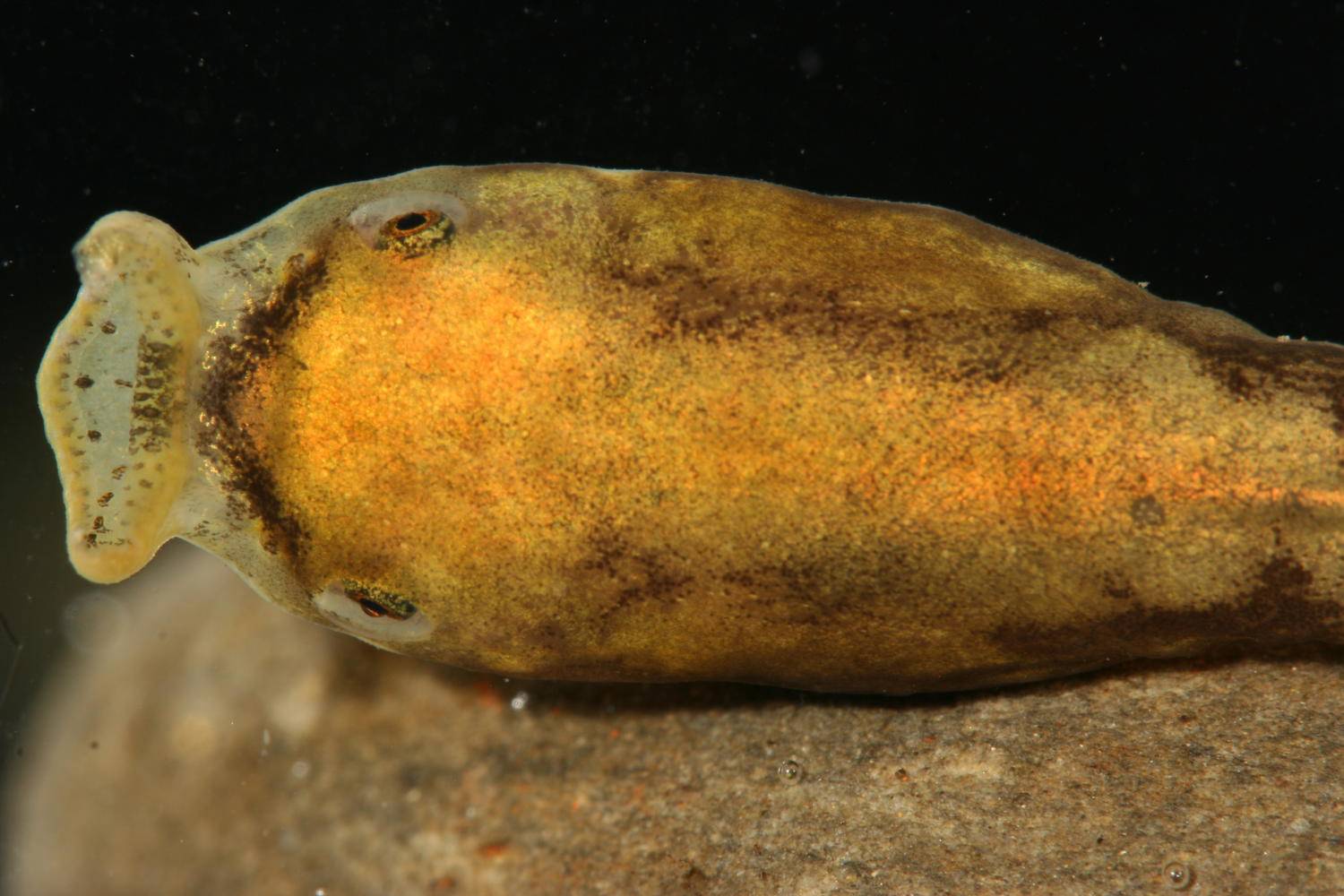
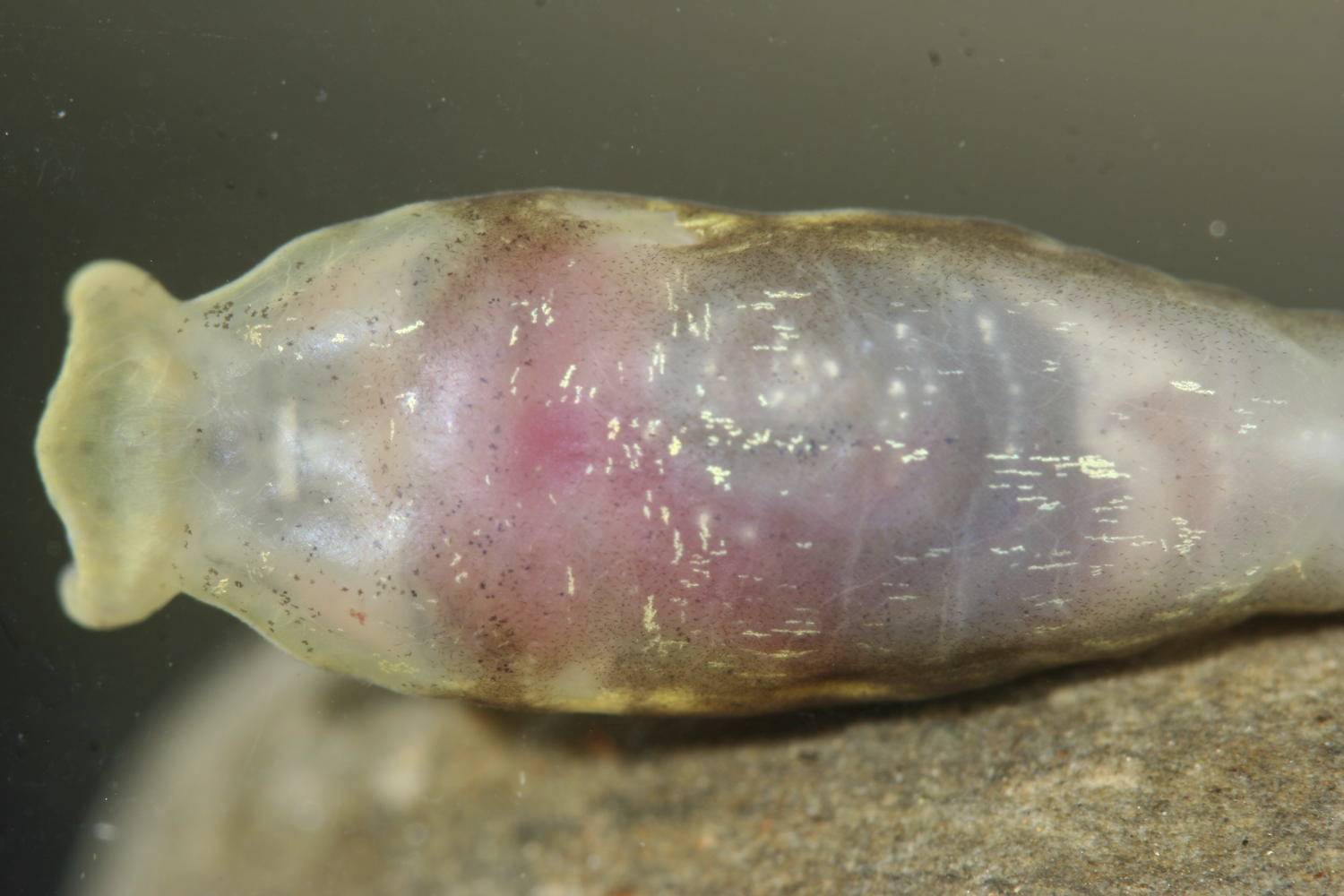
Generally brown dorsally. Background coloration of body and tail grayish, slightly lighter at the snout, with beige to brown pattern elements. Dorsal and lateral surfaces of body and tail show a conspicuous pattern of intense dark brown and gold pigmentation. Dorsal surface of head and trunk covered by shiny gold pigmentation extending laterally to below the eye. Two diffuse bands of dark brown melanocytes present dorsolaterally. A distinct, broad V-shaped dark band extends between the anterior margins of the eyes and the medial point of the upper lip. Lips light beige, with lateral tips golden. Venter grayish and semitransparent with scattered melanocytes, possibly increasing toward the end of larval development; scattered iridocytes present, particularly in the abdominal region. Tail darkly pigmented with melanocytes; myosepta somewhat accentuated by melanocyte density. Melanocyte pigmentation extends onto the tail fins, especially posteriorly, whereas the anterior part of the lower tail fin is only lightly pigmented. Gold iridocyte blotches from the dorsum extend onto the upper tail fin, particularly along the anterior third, which is marbled with golden beige and dark flecks. Lateral tail vein faintly visible.

Snout

Smoothly narrowing toward the base of the oral funnel in both lateral and dorsal views.

Oral Disc

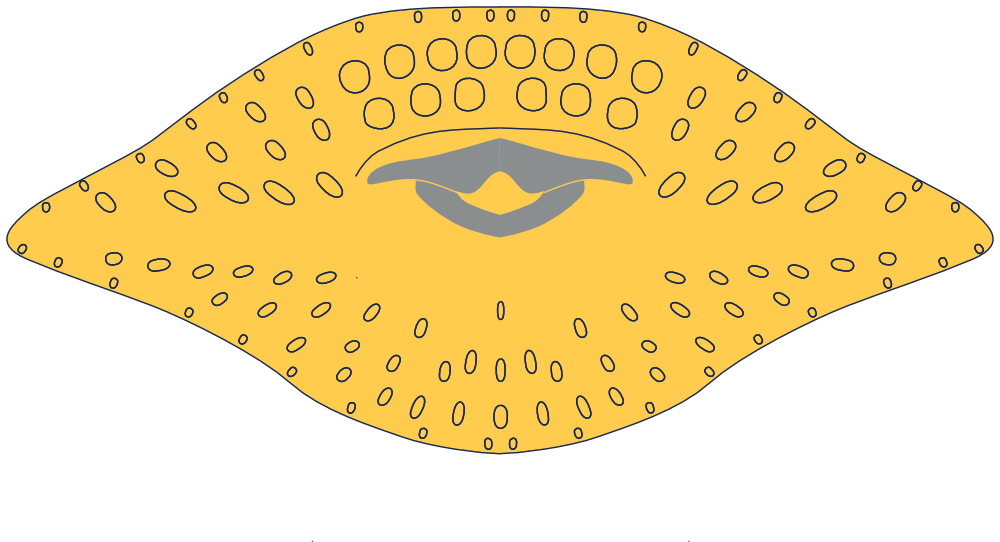
Terminal, umbelliform, and directed upward. Oral disc expanded to approximately body width, rhomboid in shape with laterally pointed corners. Ventral (anterior) lip sinuate and deeper than the upper lip. In resting position, disc margins are curled inward and the two corners project upward like horns; during surface feeding, the oral disc spreads fully. Marginal papillae absent. Numerous dark brown, round to elongate submarginal papillae (ridges) present, arranged in rows and oriented toward the mouth; large papillae present in the dorsal sector of the disc. Beaks thin and weakly keratinized (not black), deeply recessed in the oral funnel and therefore difficult to discern. Upper jaw with a medial embayment.

Body

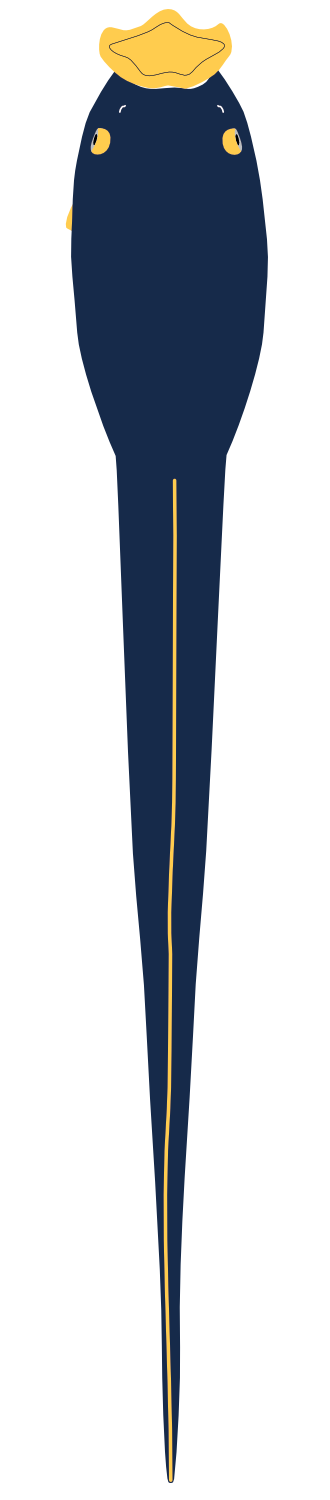
Moderate in size and slender. In lateral view, head and trunk only slightly dorsoventrally depressed. In dorsal view, body elongate, approximately twice as long as wide, more parallel-sided than oval, broader in the head region than in the trunk. Trunk wider than the base of the tail. Body widest at the gill region. Spiracle sinistral, forming a short siphon with a free, round spiracular orifice; opening situated below the horizontal midline of the trunk. Spiracular siphon directed posterodorsally. Lateral line organs indistinct.

Eyes & Nostrils

Eyes dorsolateral, widely spaced, without cornea protruding beyond the body contour in dorsal view. Nostrils oval, opening laterally, closer to the eye than to the snout. Nostril rim slightly raised from the body wall and bearing a small, short middorsal projection. Sclera black with gold-yellow iridocyte stippling. Iris stippled dark gold-yellow to orange on a black background.

Tail

Approximately 70% of total length, including the oral funnel. Muscular part strong, nearly as high as the body in lateral view. Dorsal fin inserts shortly posterior to the trunk-tail junction; lower fin connected to the trunk. Fin margins almost straight. Posteriorly, fins taper into a pointed tip. Dorsal and ventral fins approximately equal in height. Skin glands absent.

Similar Species

Tadpoles of Sarawakiphry dringi and some Pelobatrachus species are currently known from small sample sizes representing limited ontogenetic stages, and intraspecific variation among surface-feeding larvae requires further study. In some regions, species-level identification may be difficult. Nevertheless, several distinguishing features have been noted: S. dringi differs from known Pelobatrachus tadpoles by its golden pigmentation on the head and dorsum and by the presence of a distinct V-shaped band anterior to the eyes. It further differs from Pelobatrachus nasutus by reduced ventral pigmentation and by the absence of a radial iris pattern. Sarawakiphrys dringi also lacks distinct black spots at the ventral base of the oral disc.

Reproduction

Details unknown.

Literature

Details unknown.