Zum Hauptinhalt springen

Frogs of Borneo

Frogs of Borneo

Frogs of Borneo

Frogs of Borneo

Frogs of Borneo

Frogs of Borneo

Frogs of Borneo

Frogs of Borneo

Frogs of Borneo

Frogs of Borneo

Frogs of Borneo

Duttaphrynus melanostictus

The small, black larvae of Duttaphrynus melanostictus inhabit temporary to semipermanent roadside ditches, flooded lawns, puddles, and ponds with silty bottoms in agricultural areas, as well as temporarily flooded parking lots. Tadpoles may co-occur with other species that readily tolerate anthropogenic landscape alteration, such as Kaloula pulchra and Fejervarya limnocharis. When present, tadpoles of D. melanostictus usually occur in large numbers. They remain on the bottom of the water body and feed on bottom particles such as algae and silt with associated microbial communities.
  • Family:
    Bufonidae
  • Genus:
    Duttaphrynus
  • Ecomorph:
    benthic, exotrophic, lentic
  • Waterbody Type:
    stagnant
  • Water Column:
    bottom
  • Feeding Type:
    feeding, generalist
  • Size:
    23 mm
  • Development:
    larva, tadpole
  • Adult:
    Duttaphrynus

Coloration

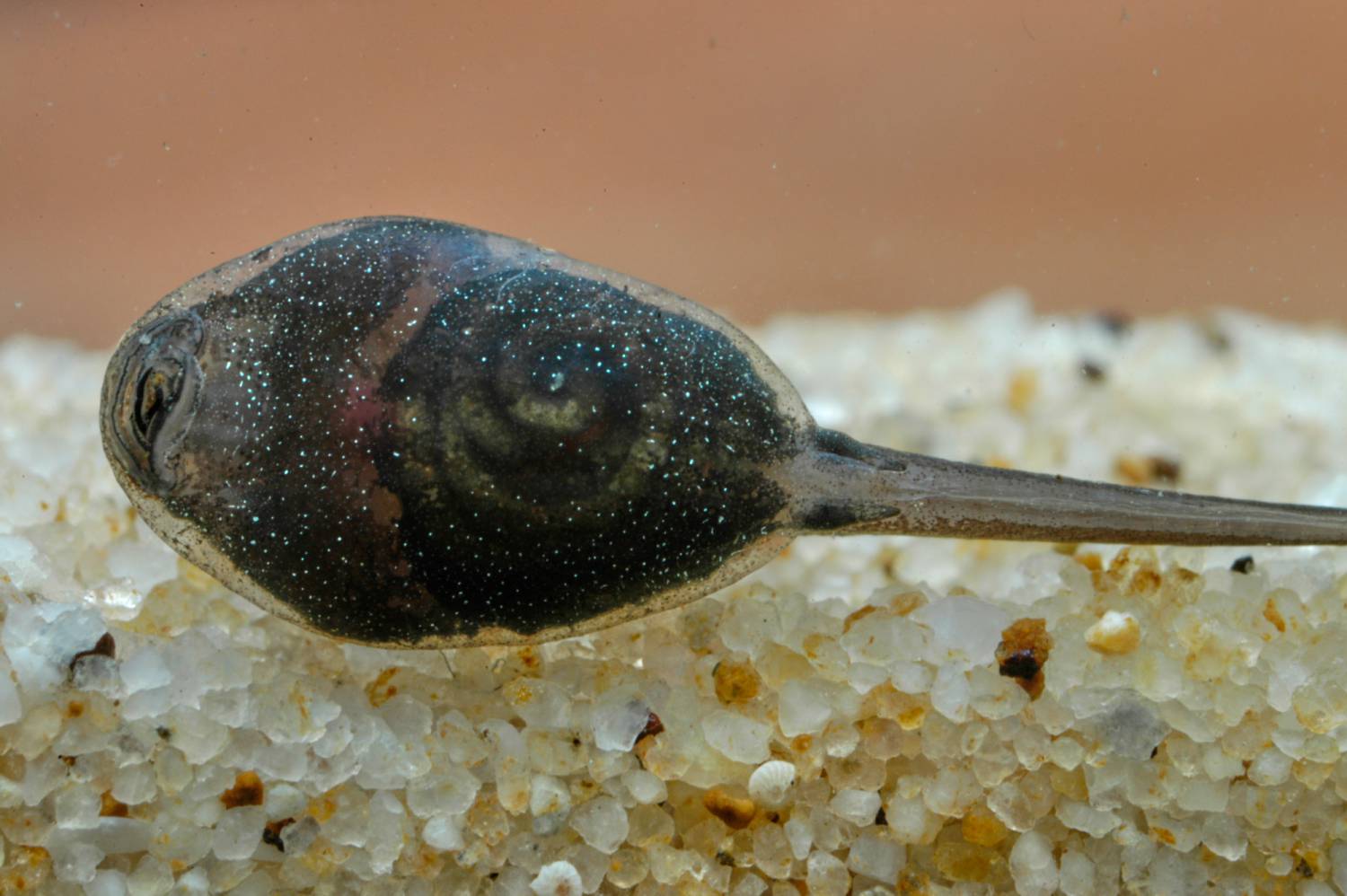
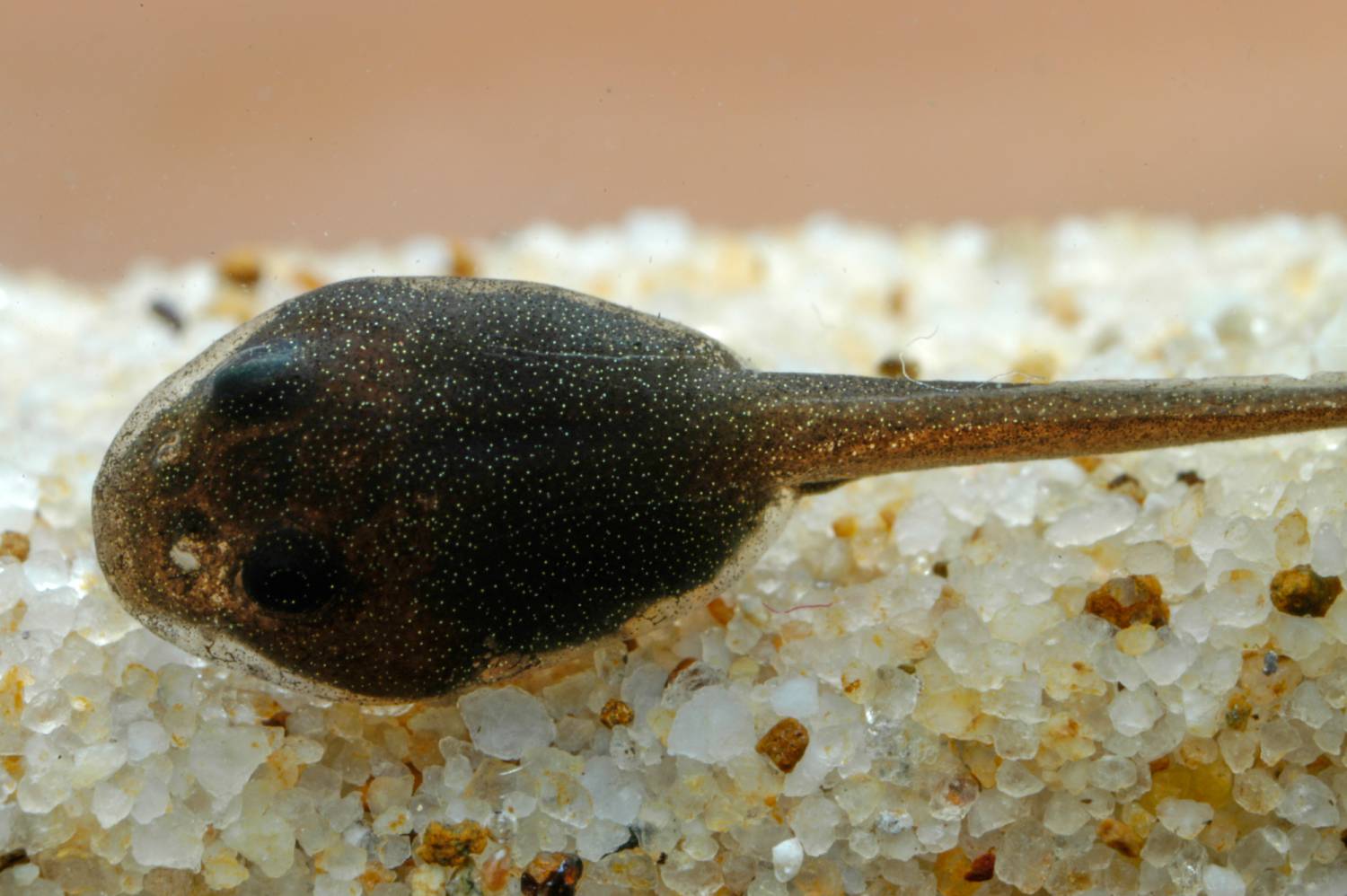
Body uniformly black; scattered, tiny white pigment cells are visible under high magnification. The muscular portion of the tail is dark brown to black; the dorsal tail fin bears scattered dark melanocytes, whereas the ventral tail fin is mostly unpigmented. Viscera are darkly pigmented and faintly visible. Much of the dark coloration is located in deeper tissue layers rather than the skin itself, producing a characteristic “double silhouette” in dorsal or ventral views. Evenly distributed, moderately dense silver iridocytes contrast with the black background at higher magnification.

Snout

In dorsal view, the snout is slightly tapering but broadly rounded. In lateral profile, it is rounded, steep, and short.

Oral Disc

Ventrally oriented. Papillation present on the lateral portions of both lips only. A clear lateral indentation separates the upper and lower lips. Two undivided labial keratodont rows on the upper lip and three on the lower lip (LTRF 2/3). Upper and lower beaks undivided and moderately robust; upper beak broadly arched. Lower jaw V- to U-shaped.

Body

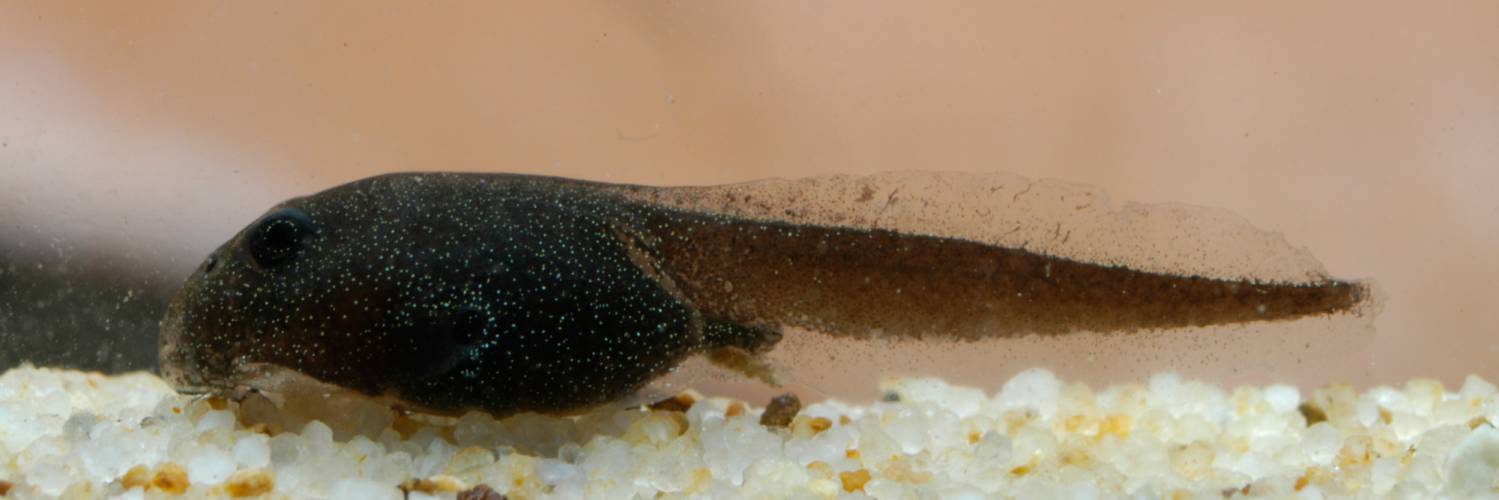
Ovoid in lateral view; weakly rhomboid in dorsal view, without a distinct constriction at the head-trunk transition. Body wider than high, i.e., slightly dorsoventrally depressed. Widest point of the body silhouette located posterior to the level of the eyes. Spiracle sinistral, attached to the body wall, and positioned below the mid-body axis in lateral view.

Eyes & Nostrils

Nostril moderately large, with a soft bulge along the medial rim; positioned closer to the eye than to the tip of the snout. Eyes dorsolateral. Iris black, with scattered iridophores around the pupil margin.

Tail

Short, approximately 58% of total length. Muscular portion moderate to narrow. Fins originate at the trunk-tail junction and rise to a moderate height, with shallowly convex margins. Upper and lower fins terminate in a blunt, rounded tip. Lateral tail vein not visible.

Similar Species

The near-rhomboidal body shape, with the widest point behind the eyes, combined with a relatively short tail, modest swimming performance, unpapillated gaps in the upper and lower lips, and an LTRF of 2/3 are characteristic of many toads (see Ansonia for exceptions). On Borneo, D. melanostictus may be confused with Ingerophrynus divergens or Ingerophrynus quadriporcatus, but can be distinguished by its deep black coloration (both dorsal and ventral) and its preference for disturbed habitats. Tadpoles of Kurixalus chaseni (Rhacophoridae) are similar in size and general body shape at first glance and inhabit forest ponds and puddles; however, they differ from D. melanostictus, I. divergens, I. quadriporcatus, and Rentapia hosii by having a fully papillated lower lip, a different keratodont arrangement, and distinct coloration.

Literature

Males clasp females around the armpits (axillary amplexus). 1.000–40.000 eggs per female spawning have been reported. Eggs are laid in strings. In sun exposed ponds, develop of eggs and tadpoles is rapid.
Leong T. M, Chou L. M. (1999) Larval diversity and development in the Singapore Anura (Amphibia). The Raffles Bulletin of Zoology 47: 81–137.

Chou, W., Lin, J. (1997) Tadpoles of Taiwan. Special Publication National Museum of Natural Science, 7: 1–98.