Zum Hauptinhalt springen

Frogs of Borneo

Frogs of Borneo

Frogs of Borneo

Frogs of Borneo

Frogs of Borneo

Frogs of Borneo

Frogs of Borneo

Frogs of Borneo

Frogs of Borneo

Frogs of Borneo

Frogs of Borneo

Hylarana megalonesa

Larvae are commonly observed in forest ponds, along clearing edges, and in stream margins. The species also breeds in stagnant pools near riverbanks. Little is known about tadpole ecology and behavior; however, the extensive skin glands may deter predators. Tadpoles appear active both day and night and spend most of their time on the bottom, occasionally moving onto submerged vegetation or twigs to feed.
  • Family:
    Ranidae
  • Genus:
    Hylarana
  • Ecomorph:
    benthic-nektonic, exotrophic, lentic
  • Waterbody Type:
    stagnant
  • Water Column:
    bottom
  • Feeding Type:
    feeding, generalist
  • Size:
    40 mm
  • Development:
    larva, tadpole
  • Adult:
    Hylarana

Coloration

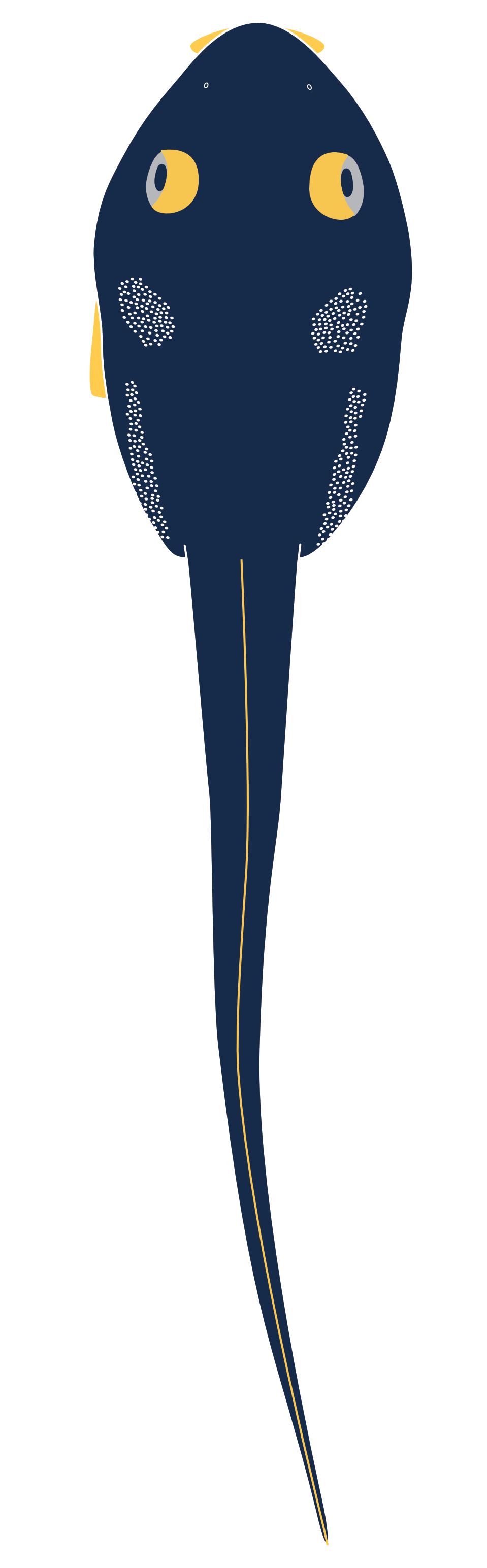
Dorsal background color ranges from ocher-yellowish to mid-brown, darker by day and lighter at night. The trunk is usually darker than the head dorsally. Dark markings typically include blotches or bands on the lateral face of the head and trunk: below the nostril, below the eye, and dorsoventrally across the gill region and flanks. Light areas between these markings give the tadpoles a distinctive facial appearance. The nostril may be embedded in a small dark spot. Opposing dark V- or W-shaped markings are often present between the eyes. Dorsal clusters of skin glands may be embedded in darker pigment. Although dark markings are characteristic, they appear reduced in some populations. Iridocytes are scattered over parts of the cheek and flank. Trunk pigmentation extends onto the muscular portion of the tail, becoming lighter toward the fins and posterior tail. The tail lacks distinct dark markings. Ventral body skin is mostly translucent, but an opaque, silvery layer may be present on the anterior abdomen. Buccal and gular skin is semitransparent and melanocyte-dusted; gills and heart are visible, the heart bearing a small patch of iridocytes. The oral disc is finely stippled with melanocytes; papillae are pigmented at their tips.

Snout

Snout tapering and relatively narrowly rounded in dorsal view. In lateral view, the snout is moderately long and slopes downward with a slightly convex profile; the region posterior to the nostril forms a weak bump.

Oral Disc

Oral disc anteroventral. Upper and lower lips separated by a distinct emargination. Marginal papillae present along the disc margin except for a broad medial gap on the upper lip. Submarginal papillae arranged in two loose rows. Marginal papillae short and rounded on the upper lip, long and finger-like on the lower lip. LTRF 3(2–3)/3 to 4(2–4)/3. Beaks well keratinized but low, undivided, with finely serrated edges; upper beak broadly arched, lower beak weakly V-shaped.

Body

Body rhomboid to oblong-oval in dorsal view, with a slight constriction posterior to the gill region; widest at the level of the gills, posterior to the eyes. Snout tapering. Body moderately dorsoventrally depressed. Spiracle sinistral, opening posteriorly into a short free tube, positioned below the mid-body axis in lateral view. Lateral line organs indistinct. Skin gland patches present dorsally above the gill region (posterior to eyes) and on the upper trunk flanks. Lungs may be visible as a series of bubbles beneath the upper flank gland field. Distinct oblong gland bands occur along the lateral abdomen, with two less distinct round patches in the buccal region posterior to the oral disc.

Eyes & Nostrils

Eyes dorsolateral. Nostrils small, closer to the snout than to the eye, oriented anterolaterally. Orbitonasal streak indistinct. Iris bordered by a golden, sometimes coppery or orange ring around the pupil; outer iris black. Sclera stippled with silvery iridophores.

Tail

Tail approximately 65% of total length. Muscular portion moderately robust and lower than body height. Upper fin begins slightly posterior to the trunk-tail junction; both fins moderately arched, the upper higher than the lower. In the posterior third of the tail, fins taper to a narrowly rounded tip. Lateral tail vein visible in the anterior third of the tail; myosepta visible in the posterior musculature.

Similar Species

Hylarana megalonesa is known from northern Sarawak, Sabah, and Brunei. H. raniceps is morphologically similar, and color pattern varies among populations; reliable tadpole characters distinguishing the two species have yet to be established. Field identification should therefore rely on adults from the same locality. Tadpoles of H. raniceps and H. megalonesa may be confused with those of Rhacophorus pardalis, which can occur in the same habitats and has a similar size range and body and tail shape. The most reliable distinguishing feature is the presence of clusters of skin glands in Hylarana raniceps and H. megalonesa (absent in R. pardalis); R. pardalis also differs in LTRF.

Literature

Males of Hylarana megalonesa gather around ponds or other suitable bodies of standing water and call from low vegetation, branches, or twigs.
Inger, R.F., Stuart, B.L., Iskandar, D.T. (2009) Systematics of a widespread Southeast Asian frog, Rana chalconota (Amphibia: Anura: Ranidae). Zoological Journal of the Linnean Society 155: 123–147.