Zum Hauptinhalt springen

Frogs of Borneo

Frogs of Borneo

Frogs of Borneo

Frogs of Borneo

Frogs of Borneo

Frogs of Borneo

Frogs of Borneo

Frogs of Borneo

Frogs of Borneo

Frogs of Borneo

Frogs of Borneo

Kaloula pulchra

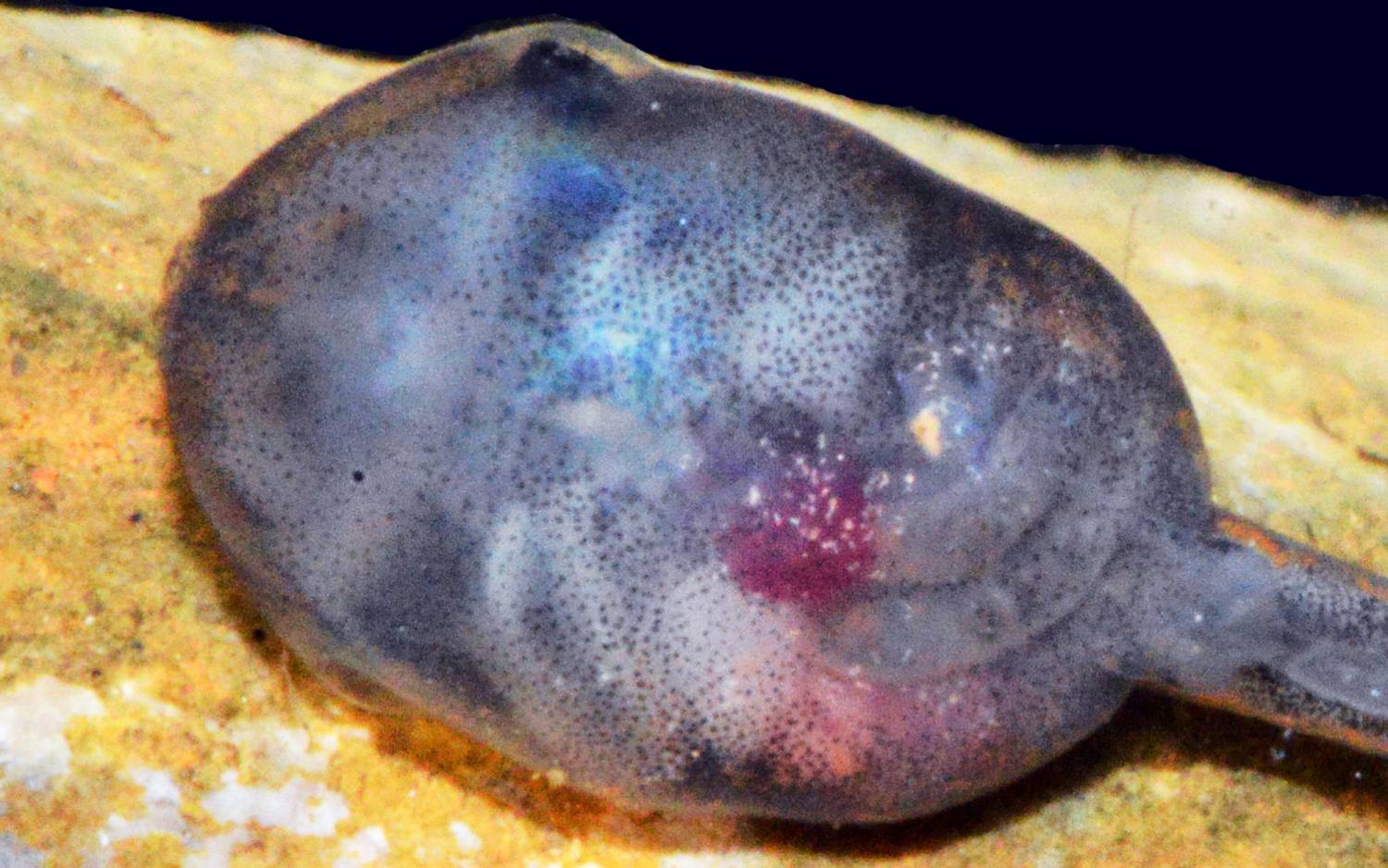
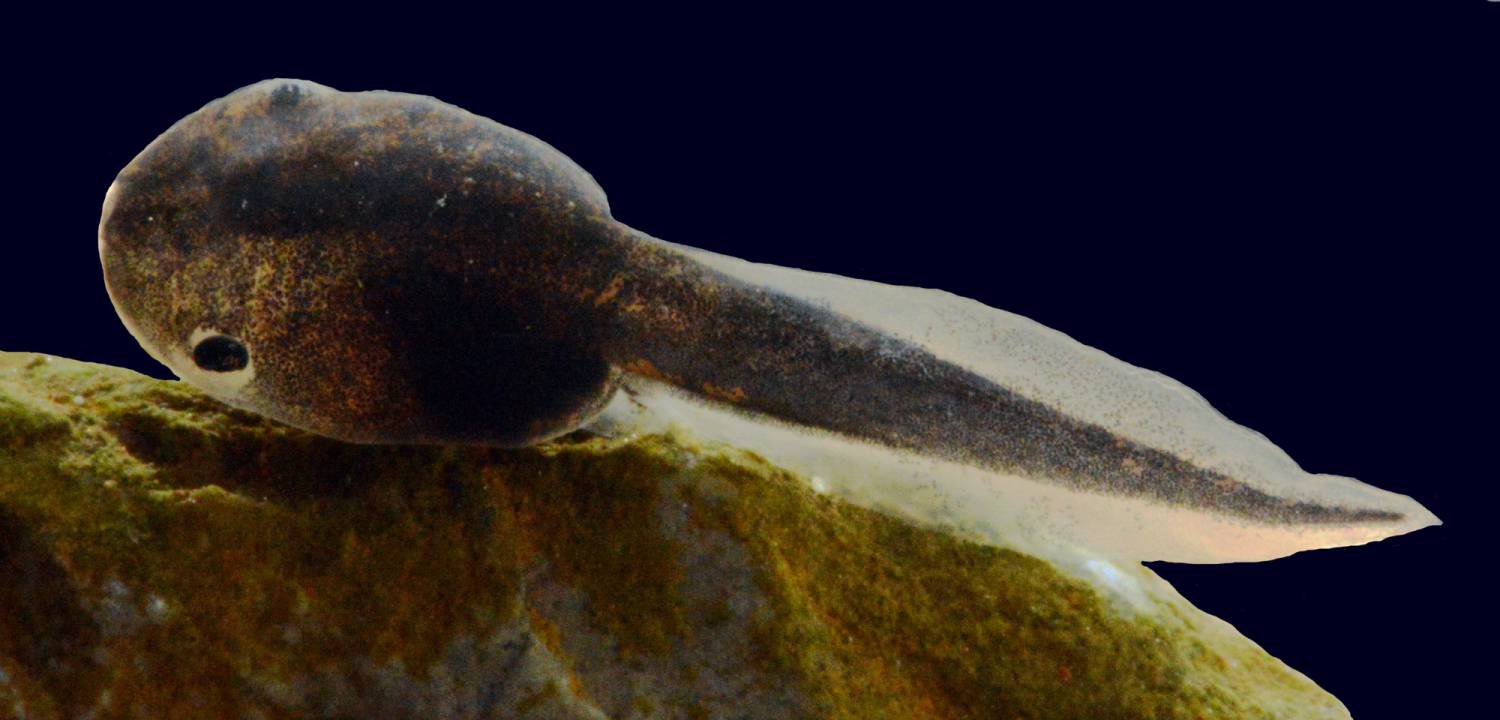
Kaloula pulchra requires stagnant bodies of water. The tadpoles are highly efficient suspension feeders but also actively exploit additional food sources, such as decaying animal and plant matter or insects at the bottom. They commonly swim up and down the water column or feed at the surface of ponds, but are also frequently observed visiting the pond bottom to ingest detrital particles. In captivity, congregations of tadpoles and schooling behavior were observed. The internal gill filter structures occupy a large portion of the head, resulting in a head that is substantially larger than the trunk in these larvae.
  • Family:
    Microhylidae
  • Genus:
    Kaloula
  • Ecomorph:
    exotrophic, lentic, suspension feeder
  • Waterbody Type:
    stagnant
  • Water Column:
    bottom
  • Feeding Type:
    feeding, suspension feeder
  • Size:
    40 mm
  • Development:
    larva, tadpole
  • Adult:
    Kaloula

Coloration

Dorsal coloration dark brown to gray, sometimes with diffuse brown to golden mottling dorsally and laterally along the tail. A faint orbitonasal streak may be present. The dark background coloration extends seamlessly onto the tail. Ventral skin well pigmented but lighter than dorsally; abdomen semitransparent, with internal organs visible at least in early developmental stages, whereas later stages become more heavily pigmented ventrally.

Snout

Snout relatively long and wide. In dorsal view, forming a very broad arch with an anterior truncation accommodating the mouthparts. In lateral view, the snout tip also appears truncated. Jaws slightly recessed.

Oral Disc

Mouth terminal; oral disc with free lips absent. Upper jaw flat medially and slightly arched laterally, with corners slightly projecting; lower jaw U-shaped. Mouth positioned within and recessed into a horizontal fold at the tip of the snout. Jaw edges lacking obvious keratinization; keratodonts absent (LTRF 0/0).

Body

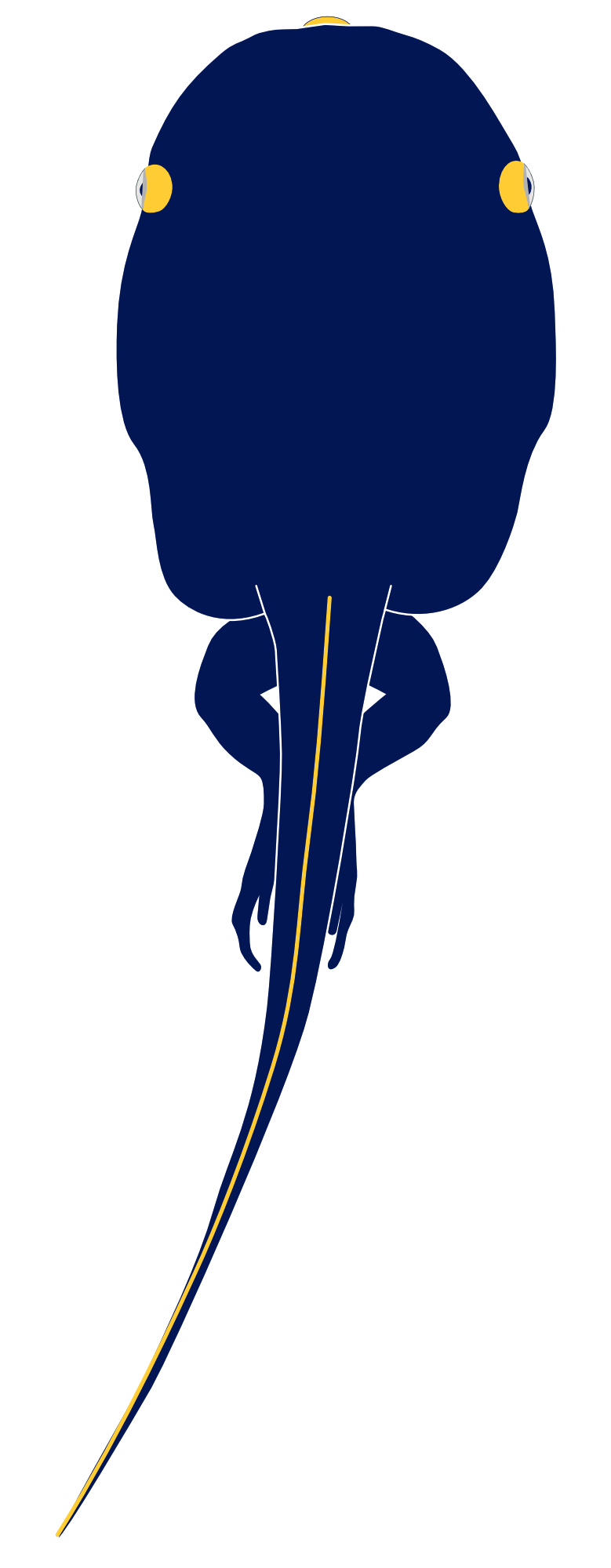
Medium-sized tadpole. Head and trunk dorsoventrally depressed, particularly in the snout region; head flat dorsally. In dorsal view, head and trunk separated by a weak constriction. In lateral view, body contour depressed ovoid, with the head noticeably tapering from just posterior to the eyes toward the snout tip. Head large relative to the smaller trunk; head wide in dorsal view. Trunk broadly rounded posteriorly and much wider than the base of the tail. Body widest at the gill region. Spiracle ventral and medial; spiracular opening forming a posteriorly directed triangular funnel. Spiracular orifice positioned posterior to the trunk, beneath the tail root and vent. Lateral line organs not visible.

Eyes & Nostrils

Eyes small, widely spaced, and positioned laterally; cornea protruding beyond the body contour in dorsal and ventral views. Iris mostly black with a metallic ring around the pupil. Sclera dorsally dotted with silver iridophores. Nostrils not perforated in larval stages; prospective nostril position inconspicuous.

Tail

Tail comprising approximately 62% of total length. Tail moderately developed but narrow relative to body size in dorsal view and much narrower than the trunk. Muscular portion considerably lower than body height in lateral view. Upper fin originating at the trunk-tail junction, rising steeply to form a convex arch in the middle section of the tail, where tail height is greatest. Posteriorly, the upper fin contour runs straight or slightly concave toward a narrowly rounded tail tip. Upper and lower fins similar in shape; lower fin as high as or slightly higher than the upper fin and reaching maximum height slightly anterior to that of the upper fin. Distinct opaque patch at the tail base absent. Skin glands absent. Lateral tail vein indistinct. Muscle myosepta faintly visible under magnification.

Similar Species

Kaloula tadpoles are relatively easy to recognize by their large head, widely spaced small lateral eyes, and the absence of an oral disc and keratinized jaw sheaths. While many of these features are characteristic of microhylid tadpoles in general, Kaloula larvae are larger than most other microhylid larvae. In addition, unlike other Bornean microhylids, the spiracle in Kaloula tadpoles is shifted far posteriorly beneath the anal siphon at the base of the tail. Larvae of K. baleata and Kaloula pulchra are similar, and intraspecific variability remains poorly understood. Diagnostic characters have not yet been established with certainty; see comments under K. baleata.

Literature

Adults congregate after heavy rain at temporary ponds and floodings within or around human settlements. Males call while floating at the water surface. The call is deep and forceful. One amplecting pair can lay a thousand eggs. Densities of tadpoles in a pond can be high. Sun exposed breeding ponds will heat up and accelerate growth and development. Metamorphosis is completed in less than four weeks.
Leong, T.M., Chou, L.M. (1999) Larval diversity and development in the Singapore Anura (Amphibia). The Raffles Bulletin of Zoology 47: 81–137.

Lalremsanga, H.T., Sailo, S., Hooroo, R.N.K. (2017) External morphology, oral structure and feeding behaviour of Kaloula pulchra TADPOLES Gray, 1831 (Amphibia: Anura: Microhylidae). Science & Technology Journal 5: 97–103.